
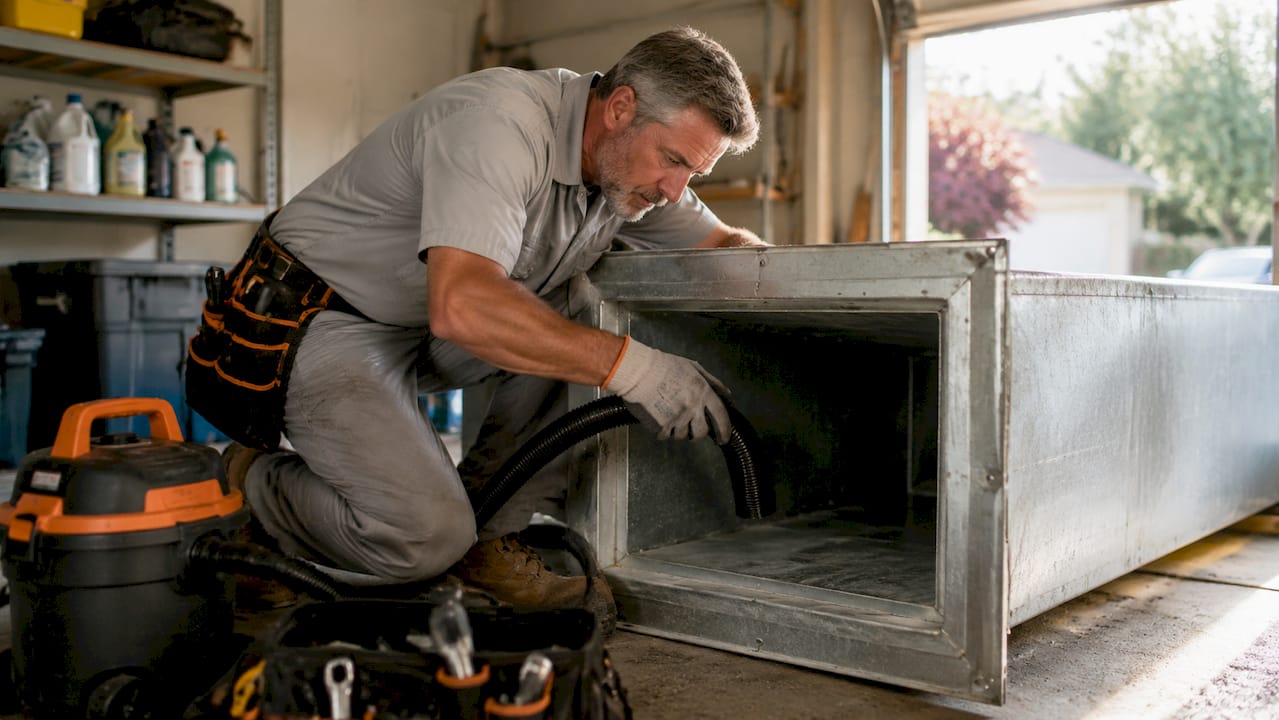
Duct cleaning is the professional removal of dust, debris, mold, and contaminants from the air ducts and HVAC components that circulate air throughout your home. The industry term for this service is “source removal cleaning,” which means physically extracting contaminants rather than simply blowing them around. The EPA notes that indoor air can be 2–5 times more polluted than outdoor air, and your HVAC system circulates that air 5–7 times every day. That scale makes your duct system worth understanding, even if cleaning it is not always necessary.
What is duct cleaning and what does it actually involve?
Duct cleaning covers every component your HVAC system uses to move air: supply ducts, return ducts, registers, grilles, diffusers, heat exchangers, cooling coils, drain pans, fan motors, and the air handler itself. Cleaning only the visible duct runs without addressing these components is not true source removal cleaning. A thorough job treats the entire system as one unit.
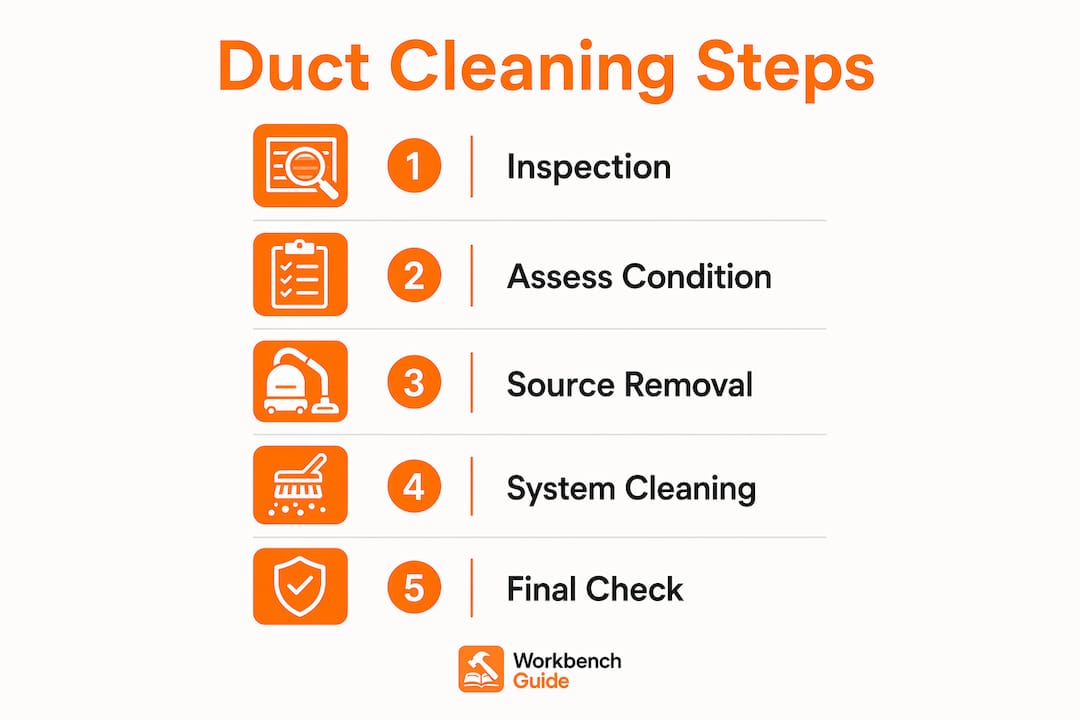
The professional duct cleaning process typically takes 3–5 hours and follows a structured sequence:
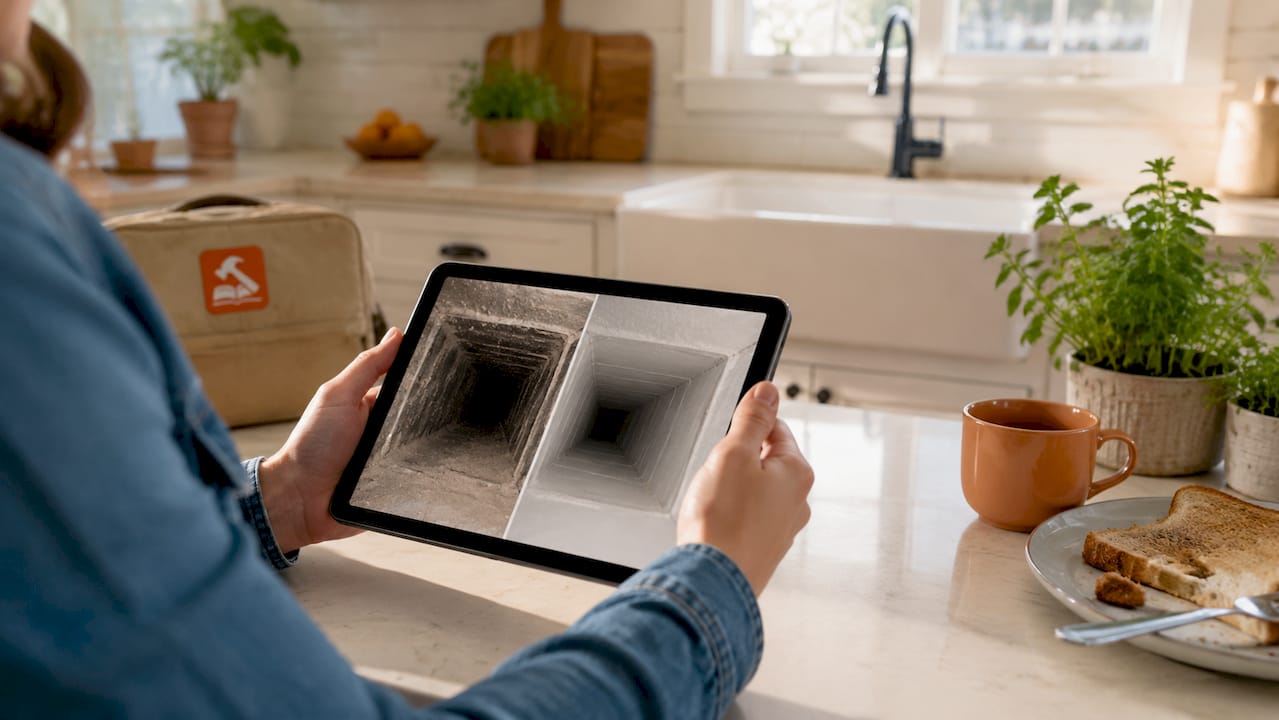
- Initial inspection. A technician inspects accessible duct sections and HVAC components, often using a camera or borescope to document existing conditions before any work begins.
- Negative pressure setup. A HEPA-filtered vacuum system connects to the main trunk line and creates negative air pressure inside the duct system. This pulls loosened debris toward the vacuum rather than into your living space.
- Mechanical agitation. Rotary brushes, air whips, and compressed air tools dislodge dust and debris from duct walls. This step is what separates a real cleaning from a basic vacuuming pass.
- Component cleaning. Technicians clean the evaporator coils, blower fan, drain pan, and air handler. Skipping these components leaves the biggest sources of contamination untouched.
- Final check. Registers and grilles are cleaned and reinstalled. A post-cleaning inspection confirms debris has been removed.
Pro Tip: Ask the technician to show you camera footage of the ducts before and after the job. Any reputable service will have this equipment and will not hesitate to use it.
When is duct cleaning actually necessary?
The EPA does not recommend routine duct cleaning on a fixed schedule. No scientific evidence supports the idea that regular cleaning prevents health problems in homes without specific contamination issues. That is a significant finding. It means most marketing claims about annual or biannual duct cleaning are not backed by science.
Duct cleaning is clearly justified in these situations:
- Visible mold growth inside ducts or on HVAC components
- Pest or rodent infestation confirmed inside the duct system
- Excessive dust discharge from registers that coats surfaces quickly after cleaning
- Recent renovation or construction that pushed drywall dust, insulation fibers, or debris into the system
- New home purchase where the duct history is unknown
- Allergy or respiratory symptoms that worsen when the HVAC runs and have no other explanation
Routine cleaning every 3–5 years is not supported by scientific evidence. Cleaning should be condition-based, triggered by one of the situations above rather than a calendar date. This matters because unnecessary cleaning costs money and, if done poorly, can make air quality worse.
Air filters are the most effective daily defense against indoor air pollution. Experts confirm that proper filter maintenance is roughly 10 times more important than duct cleaning for day-to-day air quality. Replacing your furnace filter on schedule does more for the air you breathe than a duct cleaning service in most homes. Learn more about filter replacement costs and why skipping it carries real health risks.
How does duct cleaning compare to other HVAC maintenance?
Duct cleaning is one tool in a larger maintenance picture. Understanding where it fits helps you spend money where it actually makes a difference.
Proper duct sealing reduces air loss by 20–30%, which delivers more energy savings than duct cleaning alone. That means a leaky duct system costs you money every month, and sealing it pays back faster than cleaning it. Cleaning a sealed, efficient system is a reasonable next step. Cleaning a leaky one first is putting the cart before the horse.
The table below compares the most common HVAC maintenance actions by their impact on cost, efficiency, and air quality.
| Maintenance action | Primary benefit | Frequency | Relative cost |
|---|---|---|---|
| Filter replacement | Daily air quality | Every 1–3 months | Low |
| Duct sealing | Energy efficiency | Once, as needed | Medium |
| Coil and fan cleaning | System efficiency | Every 1–2 years | Medium |
| Full duct cleaning | Contaminant removal | Condition-based | Medium to high |
| HVAC tune-up | Overall performance | Annually | Low to medium |
Cleaning the coils and fan motor delivers the biggest efficiency gains within the HVAC system itself. Cleaning critical HVAC components like coils and fan motors improves system efficiency far more than cleaning ductwork alone. This is why a full system cleaning, not just a duct pass, is worth the investment when you do decide to hire a service.
Pro Tip: Schedule coil cleaning and filter replacement together once a year. That single habit does more for your HVAC’s lifespan and your air quality than any other maintenance combination.
For a full picture of how HVAC efficiency is measured and maintained, the Workbenchguide guide on the topic breaks it down clearly for homeowners.
How to choose a qualified duct cleaning service
The duct cleaning industry has a well-documented problem with low-quality providers. A rushed job can leave your ducts dirtier than before. A cleaning under 90 minutes almost always fails to remove deeply embedded dust and risks resuspending contaminants into your home’s air. That is not a minor issue. It means a bad cleaning actively harms your indoor air quality.
Watch for these red flags when evaluating a service:
- Quotes under $100 for a whole-home cleaning
- No mention of negative pressure or HEPA vacuum equipment
- Technicians who complete the job in under 90 minutes
- Pressure to add chemical biocides or sealants as standard treatment
- No camera inspection offered before or after the job
A legitimate service uses vacuum systems generating over 3,000 CFM of negative pressure to pull debris out of the system effectively. Anything less leaves contamination behind. The vacuum must exhaust to the outside, not into your home.
On chemical treatments: the EPA recommends extreme caution with biocides and sealants inside ducts. These products are not fully researched for long-term safety, and their use should be limited to specific cases after physical cleaning is complete. Decline any service that pushes chemical treatment as a routine add-on.
Request before-and-after visual proof of the duct interior, either video or photos from a camera or borescope. This is the only reliable way to confirm the job was done. A technician who refuses this request is telling you something important about the quality of their work.
Pro Tip: Look for technicians certified by the National Air Duct Cleaners Association (NADCA). Certification requires training in source removal methods and proper equipment standards.
Key takeaways
Duct cleaning delivers real value only when done correctly, under the right conditions, using source removal methods with HEPA-filtered negative pressure equipment.
| Point | Details |
|---|---|
| Definition matters | Duct cleaning covers the full HVAC system, not just the visible duct runs. |
| Condition-based only | Clean ducts when mold, pests, or excessive dust are confirmed, not on a fixed schedule. |
| Filters come first | Replacing your air filter regularly does more for daily air quality than most duct cleanings. |
| Quality over frequency | A rushed cleaning under 90 minutes can worsen air quality by resuspending debris. |
| Verify the results | Always request before-and-after camera footage to confirm the job was effective. |
What I’ve learned about duct cleaning after years of home maintenance advice
Most homeowners I talk to fall into one of two camps. Either they have never thought about their ducts at all, or they have been scared into booking an annual cleaning by a company with a $99 special. Both positions miss the point.
The honest truth is that your air filter is doing the heavy lifting every single day. If you are changing it on schedule and your HVAC is running well, your ducts are probably fine. The cases where duct cleaning genuinely matters are specific: visible mold, confirmed pests, post-renovation debris, or a home with unknown history. Outside of those situations, a good filter and annual coil cleaning will serve you better.
What I find most frustrating is the number of “quick clean” services that charge $150, spend 45 minutes in the house, and leave without ever creating proper negative pressure. That is not cleaning. That is theater. And it can actually make things worse by disturbing settled dust without capturing it. If you are going to spend money on this, spend it on a service that brings the right equipment and takes the time to do it properly.
The source removal philosophy now guiding the HVAC industry is the right framework. Fix the source of contamination, maintain your filters, seal your ducts if they leak, and clean the whole system only when conditions actually call for it. That approach protects both your air quality and your wallet.
— Sean
Duct cleaning and your home maintenance plan
Duct cleaning fits into a broader picture of keeping your home running well and avoiding expensive repairs. Workbenchguide makes it easier to stay on top of every maintenance task, from HVAC filter reminders to seasonal checklists, so nothing gets missed. The home maintenance checklist on Workbenchguide covers HVAC care alongside every other system in your home, with clear guidance on what to do and when. Preventive maintenance costs a fraction of what emergency repairs run, and having a structured plan is the difference between catching a problem early and replacing a furnace. Workbenchguide also offers step-by-step HVAC maintenance guides built specifically for homeowners who want to stay ahead of issues without needing a contractor for every task.
FAQ
What is duct cleaning in simple terms?
Duct cleaning is the professional removal of dust, debris, and contaminants from your home’s air ducts and HVAC components using specialized vacuum and agitation equipment. The goal is source removal, meaning contaminants are physically extracted rather than redistributed.
How often should air ducts be cleaned?
Duct cleaning should be condition-based, not scheduled. The EPA finds no scientific evidence supporting routine cleaning; clean only when mold, pests, or excessive dust buildup are confirmed.
How long does a professional duct cleaning take?
A thorough professional duct cleaning takes 3–5 hours. Any service completed in under 90 minutes is unlikely to remove deeply embedded debris and may worsen air quality.
Does duct cleaning actually improve air quality?
Duct cleaning can improve air quality when genuine contamination exists, but air filter replacement has a far greater impact on daily indoor air quality for most homes. Poorly done cleaning can make air quality worse by resuspending settled dust.
What should I ask a duct cleaning company before hiring them?
Ask whether they use HEPA-filtered vacuum systems generating over 3,000 CFM of negative pressure, and request before-and-after camera footage of the duct interior. Decline any company that cannot answer both questions clearly.