

Childproofing is the practice of modifying your home to eliminate or reduce hazards that cause injury to young children. Every year, children ages 1–4 sustain hundreds of thousands of injuries inside the home, and the majority of those incidents are preventable. Knowing how to childproof your home before a child reaches a new developmental milestone is far more effective than reacting after an accident. This guide walks you through the highest-risk areas, the best childproofing products and methods, and a practical child safety checklist you can use today.
What are the most common home hazards for children?
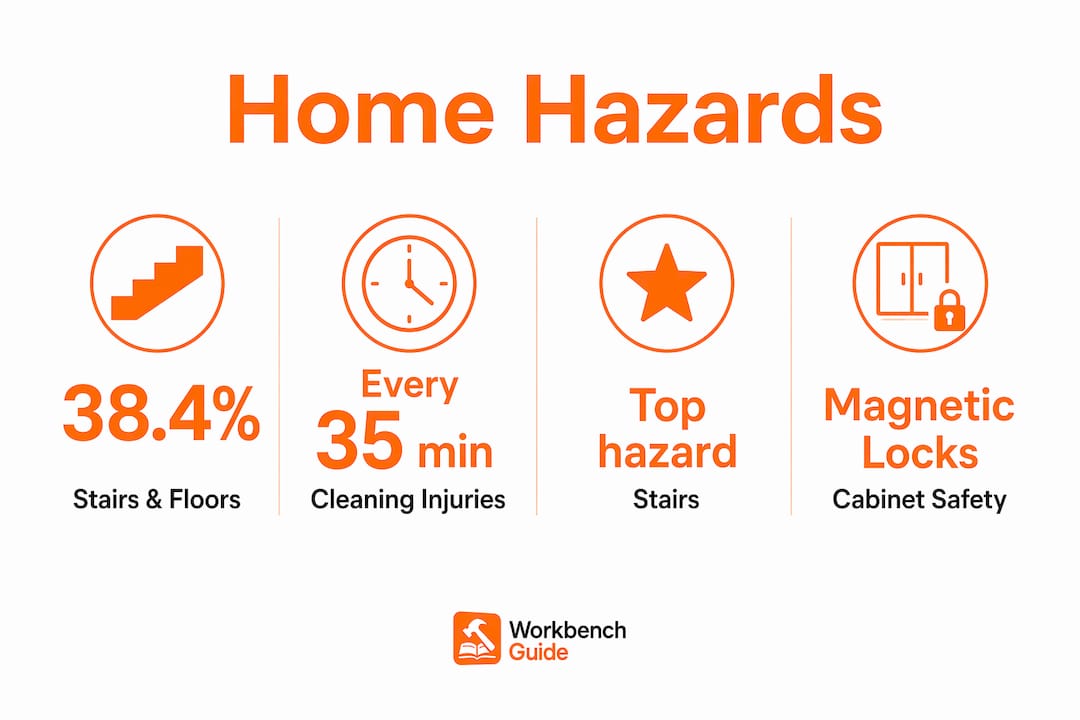
Stairs and floors are the single biggest threat to young children at home. Household stairs and floors account for 38.4% of over 8.3 million domestic incidents recorded in 2024. That figure means nearly 4 in 10 child injuries happen on surfaces parents walk across every day without a second thought.
Poisoning is the second major category. From 2007 to 2022, cleaning products caused one child injury every 35 minutes for children 5 and under. Detergent packets alone caused 33% of those injuries, and poisoning accounted for 64% of all cleaning product incidents. Laundry pods look like candy to a toddler, and their concentrated formula causes serious harm within minutes of ingestion.
Product recalls add another layer of risk. In 2025, 45% of children’s product recalls involved violations of mandatory safety standards, including child-resistant packaging failures. Over 40 million items were affected across 420 recalls. Checking the Consumer Product Safety Commission recall database before buying or using any children’s product is a non-negotiable step.
The hazards that cause the most injuries share one trait: they are ordinary objects in ordinary places. Here are the categories that demand your attention first:
- Stairs and landings: Falls on stairs send more children to emergency rooms than any other single home feature.
- Cleaning products and medications: Laundry pods, dishwasher tablets, and over-the-counter medicines are the top poisoning sources.
- Unsecured furniture: Dressers, bookshelves, and TVs tip over onto children who pull or climb on them.
- Electrical outlets: Uncovered outlets attract curious fingers and small objects.
- Window hazards: Window screens provide no fall protection. A child leaning against a screen can fall through it.
Falls are the most common reason children visit emergency rooms, and blocking stairs with safety gates while keeping walkways clear are among the most effective steps a caregiver can take to reduce that risk.
Understanding why each hazard causes injury helps you prioritize where to spend time and money. A stair gate costs less than an ER visit and installs in under an hour.
Room-by-room childproofing: kitchen, living areas, and bedrooms
Kitchen safety
The kitchen concentrates more hazards per square foot than any other room. Heat, sharp objects, and toxic chemicals all share the same space where children often want to be near a parent.
- Lock all lower cabinets. Install magnetic cabinet locks on any cabinet containing cleaning supplies, knives, or heavy cookware. Spring-loaded latches work but are easier for older children to defeat.
- Secure the stove. Stove guards and knob covers significantly reduce burn injuries by blocking access to hot surfaces and preventing children from turning burners on.
- Store cleaning products up high. Move all cleaning supplies to a locked cabinet above counter height. Never leave a detergent pod on the counter, even briefly.
- Keep the refrigerator locked. A refrigerator lock prevents access to raw meat, alcohol, and medications stored in the fridge.
- Turn pot handles inward. A pot handle extending over the stove edge is a pull hazard for any child tall enough to reach the counter.
Pro Tip: Never store cleaning products under the sink without a magnetic lock. Spring latches give children enough time and resistance to eventually defeat them, especially toddlers who are motivated and persistent.
Living room and common areas
The living room is where children spend most of their waking hours, which makes it a high-exposure zone. Furniture tip-overs, fireplace burns, and window falls are the three biggest risks.
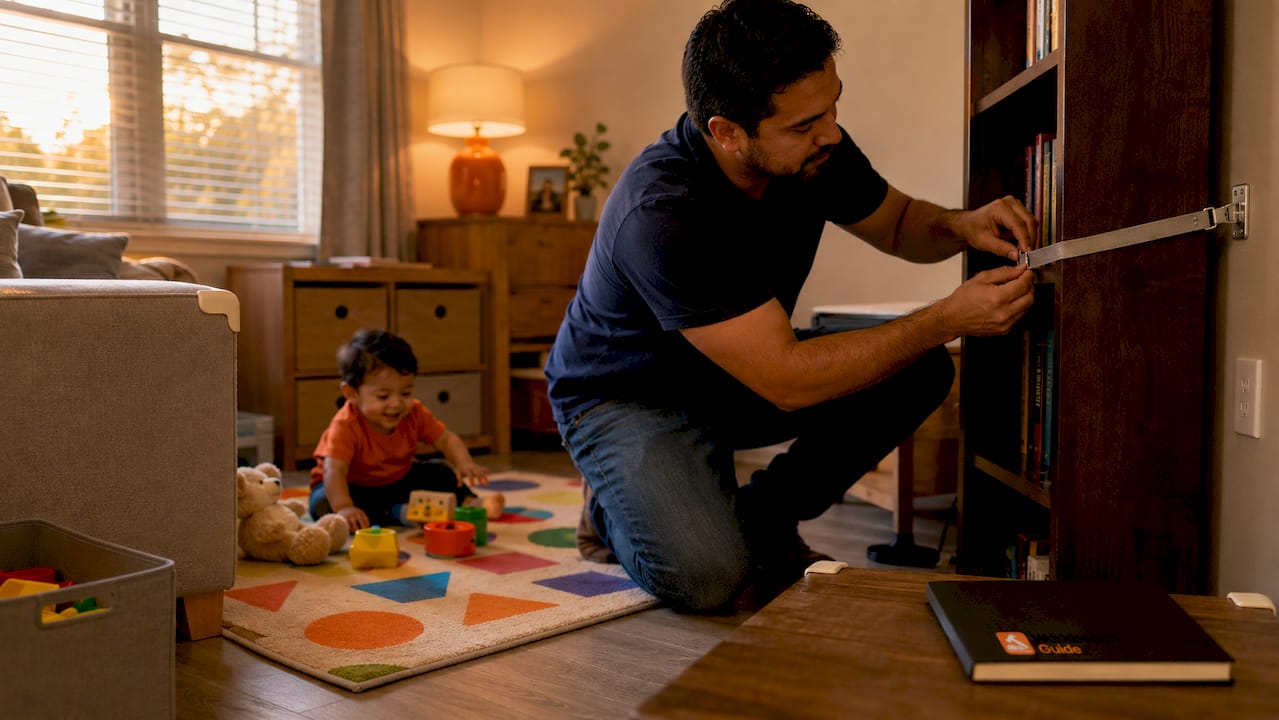
Anchor every tall piece of furniture to a wall stud using anti-tip straps. This includes bookshelves, dressers moved into living spaces, and television stands. A flat-screen TV mounted on a stand is one of the most common tip-over hazards in American homes. Mount the TV directly to the wall or use a furniture strap rated for the TV’s weight.
Window screens are inadequate fall prevention devices. Install window stops or guards that limit how far a window can open. Move all furniture away from windows so children cannot use a couch or chair as a climbing platform. For fireplaces, install a freestanding hearth gate that surrounds the entire fireplace opening, not just a screen that a child can pull aside.
Cover every unused electrical outlet with a sliding plate cover. Plug-in plastic caps are a choking hazard if a child removes them. Sliding plate covers replace the outlet cover entirely and require an adult-level pinch-and-slide motion to open.
Bedroom safety
Cribs must meet current Consumer Product Safety Commission standards. Drop-side cribs have been banned since 2011. The crib mattress should fit snugly with no gap larger than two fingers between the mattress and the crib frame. Remove all pillows, bumpers, and loose blankets from the crib until the child is at least 12 months old.
For older children using bunk beds, install guardrails on both sides of the upper bunk, not just the wall side. Secure all dressers and wardrobes to the wall. Store toys in low, open bins rather than deep toy chests with heavy lids, which can trap a child’s head or fingers.
How to manage invisible and evolving risks as children grow
Childproofing is not a one-time project. Periodic reassessment prevents new hazards from appearing as children develop new physical abilities. A safety setup that works for a crawling 9-month-old will fail for a walking 18-month-old who can now reach countertops and door handles.
The most effective technique for finding hidden hazards is to get down to your child’s eye level, roughly 12–24 inches from the floor. From that height, you will see dangling cords, reachable outlets, and small objects that are invisible from adult standing height. Do this in every room at least once every three months.
Pro Tip: Set a recurring quarterly reminder to walk through every room at child height. Children’s reach and climbing ability change faster than most parents expect. What was safely out of reach last month may not be this month.
Key reassessment triggers include:
- First crawling: Secure outlets, remove floor-level choking hazards, install stair gates.
- First walking: Pad sharp furniture corners, move breakables above waist height, lock all lower cabinets.
- First climbing: Anchor all furniture, remove climbable objects near windows, reassess stair gate height.
- Starting to open doors: Install door knob covers and door pinch guards on all interior doors.
Safe storage habits also need to evolve. A child who cannot open a childproof cap at age 2 may figure it out by age 4. Safety latches and child-resistant packaging are child-resistant, not childproof. Never rely on them as your only barrier between a child and a hazardous substance.
Step-by-step checklist and tools to start childproofing safely
Use this table as your starting point for selecting the right safety devices for each area of your home.
| Safety device | Where to use it | What it prevents |
|---|---|---|
| Magnetic cabinet locks | Kitchen and bathroom cabinets | Access to chemicals, medications, sharp objects |
| Stair safety gates | Top and bottom of every staircase | Falls on stairs |
| Anti-tip furniture straps | All tall furniture and TVs | Tip-over injuries |
| Outlet sliding plate covers | Every unused outlet | Electrical shock and choking on plastic caps |
| Window stops or guards | All windows above ground floor | Falls from windows |
| Stove knob covers and guards | Kitchen stove | Burns from hot surfaces |
| Door pinch guards | All interior doors | Finger injuries from door closures |
| Smoke and carbon monoxide detectors | Every level and near sleeping areas | Fire and CO poisoning fatalities |
Installing smoke and carbon monoxide detectors on every level of the home and near sleeping areas is one of the most overlooked steps in a standard child safety checklist. Most childproofing guides focus on physical barriers and miss this entirely.
Follow these steps to work through your home systematically:
- Start with the highest-traffic rooms. Kitchen, living room, and the child’s bedroom carry the most daily risk. Address these before moving to bathrooms, laundry rooms, or garages.
- Install stair gates first. Falls on stairs are the leading cause of child injuries. Gates at both the top and bottom of every staircase are non-negotiable. Use a hardware-mounted gate at the top of stairs, never a pressure-mounted one, which can be pushed out.
- Audit every cabinet at child height. Open every cabinet below counter height and remove or relocate anything hazardous. Then install magnetic locks.
- Check medications separately. Never label medicine as “candy” to encourage a child to take it. Store all medications in a locked box, not just a high shelf. Post the Poison Control number (1-800-222-1222) on your refrigerator.
- Anchor furniture and electronics. Use anti-tip straps rated for the weight of each item. Check that wall anchors are drilled into studs, not just drywall.
- Test every device after installation. Pull on cabinet locks, push on stair gates, and try to open outlet covers. A device installed incorrectly provides no protection.
Pro Tip: Pair your childproofing walk-through with a seasonal home inspection. A room-by-room safety evaluation each season catches both childproofing gaps and general maintenance issues before they become expensive problems.
For a deeper look at electrical hazards specifically, the Workbenchguide electrical safety checklist covers outlet types, wiring risks, and GFCI protection in detail.
Key Takeaways
Effective childproofing requires securing the home room by room, reassessing safety measures as children develop, and never relying on child-resistant devices as a sole barrier against hazards.
| Point | Details |
|---|---|
| Stairs are the top hazard | Hardware-mounted stair gates at the top and bottom of every staircase are the single highest-priority install. |
| Cleaning products cause frequent poisoning | Store all detergents and chemicals in locked, high cabinets and post Poison Control (1-800-222-1222) visibly. |
| Reassess every three months | Children’s reach and climbing ability change fast; walk through each room at child eye level quarterly. |
| Child-resistant is not childproof | Safety latches and caps reduce risk but are not foolproof; always add a second barrier for toxic substances. |
| Detectors save lives | Smoke and carbon monoxide detectors on every level are a critical, often-skipped step in home safety. |
What I’ve learned about childproofing that most guides skip
Most childproofing articles hand you a product list and call it done. What they miss is the psychological side of keeping a home safe over time.
The hardest part of securing your home for kids is not the installation. It is the maintenance. Parents get busy, devices get bypassed for convenience, and cabinet locks get left open “just this once.” That habit is where accidents happen. The physical modifications matter, but the daily discipline of closing every lock and replacing every cover matters more.
I have also seen parents over-rely on supervision as a substitute for physical barriers. Supervision is not a childproofing strategy. It is a complement to one. A child can reach a stove knob in the two seconds it takes to answer a phone. Physical barriers buy you time. Time is what prevents injuries.
The other thing worth saying plainly: do not wait until your child is mobile to start. The best time to childproof is before the child arrives or reaches a new milestone, not after the first close call. A home safety inspection done proactively is worth ten reactive fixes done in a panic.
Teaching children about safety is also part of the equation, but it is a long game. A 2-year-old cannot reliably remember not to touch the stove. A 5-year-old can start to understand why certain rules exist. Adjust your expectations to match your child’s actual cognitive stage, not the stage you wish they were at.
— Sean
Workbenchguide can help you stay on top of home safety
Childproofing is not a single project with a finish line. It is an ongoing part of home maintenance that needs to be revisited as your child grows and as your home changes. Workbenchguide gives you the structure to stay ahead of it. The home maintenance checklist on Workbenchguide includes safety inspection tasks you can schedule by season, so nothing gets missed between the busy months. You can track completed tasks, set reminders for quarterly walk-throughs, and access step-by-step DIY guides for every fix on your list. Keeping your home safe for kids is easier when you have a system, not just a to-do list.
FAQ
What age should I start childproofing my home?
Start before your child becomes mobile, ideally before 6 months of age. Crawling typically begins between 7 and 10 months, and hazards that seem out of reach change quickly once a child starts moving.
Are pressure-mounted stair gates safe?
Pressure-mounted gates are safe at the bottom of stairs but should never be used at the top. A child pushing against a pressure-mounted gate at the top of stairs can dislodge it and fall. Always use a hardware-mounted gate at the top.
What is the Poison Control number in the United States?
The national Poison Control number is 1-800-222-1222. Post it on your refrigerator and save it in your phone. Call immediately if you suspect a child has ingested any medication, cleaning product, or unknown substance.
How often should I update my childproofing setup?
Reassess every three months or whenever your child reaches a new developmental milestone such as crawling, walking, or climbing. Childproofing requires ongoing effort because children’s abilities change faster than most parents anticipate.
Do window screens prevent falls?
No. Window screens are designed to keep insects out, not to support a child’s weight. Install window stops or guards that limit how far a window opens, and move all furniture away from windows to eliminate climbing access.
Leave a Reply