
Rental property maintenance is the mix of scheduled upkeep and reactive repair work landlords run to keep units safe, habitable, and generating income. Skip it, and small problems (a slow leak, a dying furnace) turn into five-figure emergencies and legal exposure.
Start with three moves this week:
- Set a preventive schedule with quarterly light checks plus heavier spring and fall rounds.
- Fund a maintenance reserve using the 1% rule (roughly 1% of property value per year) or a per-square-foot benchmark as your baseline.
- Document every visit with a date, photos, and an invoice, since the implied warranty of habitability obligates you to keep units fit to live in, and courts want a paper trail when disputes happen.
Get those three habits running and most of what follows is refinement, not reinvention.
Key Takeaways
Rental property maintenance succeeds when landlords combine a legally grounded response standard with a funded reserve, a season-based schedule, and photo-backed documentation for every repair.
| Point | Details |
|---|---|
| Habitability is non-negotiable | The implied warranty of habitability requires working heat, plumbing, electrical, and structural safety in nearly every state. |
| Budget with two benchmarks | Use the 1% rule (1% of property value annually) alongside the $1 to $2 per square foot benchmark to size your reserve. |
| Follow a season-based calendar | Run quarterly light checks plus spring and fall heavy rounds to catch failures before they become emergencies. |
| Document everything | Log date, task, before/after photos, and invoice for every visit to defend against disputes and support insurance claims. |
| Use Workbench Guide to run the system | Workbench Guide centralizes maintenance calendars, multi-property tracking, and photo/invoice logging so the schedule above actually gets followed. |
Table of Contents
- What Rental Property Maintenance Law Requires of Landlords
- What Are the Main Types of Rental Maintenance?
- What Should a Landlord Budget for Maintenance Costs?
- Building a Rental Property Maintenance Schedule
- Common Rental Repairs and What They Typically Cost
- Operational Systems Every Landlord Should Run
- How Workbench Guide Helps Landlords Run This System
- Where to Verify Landlord Legal and Safety Standards
- What Most Landlords Get Backward About Maintenance
- Workbench Guide Turns This Playbook Into a System You Actually Run
- Frequently Asked Questions
- Sources
What Rental Property Maintenance Law Requires of Landlords
Every state except a handful recognizes the implied warranty of habitability, a legal doctrine that requires landlords to keep rental units livable regardless of what the lease says. That means working heat, functioning plumbing, safe electrical and gas systems, and a structurally sound building. You cannot waive this duty with a clause, and a tenant cannot sign it away either.
The law does not treat every repair the same. A collapsed water heater in January demands same-day or next-day action; a dripping bathroom faucet can usually wait a week. Exact timelines vary by state and sometimes by city, so check your local housing code before assuming a “reasonable time” standard applies uniformly. Many jurisdictions give landlords anywhere from 24 hours (no heat, no water) to 30 days (cosmetic issues) to respond, and state landlord repair laws spell out tenant remedies like repair-and-deduct or rent withholding when you miss those windows.
Entry rules matter just as much as repair timelines. Most states require 24 to 48 hours’ written notice before entering an occupied unit for non-emergency maintenance, and skipping that step can void an eviction case or draw a harassment complaint even when your intentions are good.
Quick reference on your core obligations:
- Maintain heat, plumbing, and electrical systems in working order year round.
- Keep structural elements (roof, foundation, stairs, railings) safe and sound.
- Give proper notice before entering, and log the notice date.
- Respond to habitability complaints on a timeline your state recognizes.
Noncompliance gets expensive fast. Beyond repair-and-deduct and rent withholding, unresolved habitability complaints can trigger code enforcement fines, lease terminations that cost you months of rent, and in the worst cases, tenant lawsuits with attorney’s fees baked in. The fix is unglamorous: respond quickly, put every action in writing, and keep photos of the property both before and after you fix something.
What Are the Main Types of Rental Maintenance?
Landlords who never sort their maintenance into categories tend to react to everything, which is the most expensive way to run a property. Sorting tasks into four buckets fixes that.
- Routine maintenance covers the small, recurring jobs: changing HVAC filters, checking smoke detector batteries, clearing gutters of debris, and touching up paint between tenants. Tenants often handle filter swaps in single-family rentals; landlords usually own detector checks and anything structural.
- Preventive maintenance is scheduled work meant to head off failure: annual HVAC servicing, water heater flushing, dryer vent cleaning, and roof inspections. This is entirely a landlord’s responsibility, and it’s the category with the best return on time spent.
- Seasonal maintenance ties to weather: winterizing exterior faucets before freeze season, servicing air conditioning ahead of summer, and clearing storm drains before heavy rain. Landlords own the systems; tenants are usually asked to report early warning signs like a struggling AC unit.
- Emergency maintenance is anything that threatens safety or habitability right now: burst pipes, no heat in winter, electrical sparking, active leaks. This always falls on the landlord, and response time here is where the implied warranty of habitability gets tested.
A property built in 1985 with original ductwork needs preventive visits more often than a 2020 build, and a coastal rental fighting salt air and humidity will burn through exterior paint and metal fixtures faster than a dry-climate property ever will. Age and climate should shift your frequency, not just your task list.
What Should a Landlord Budget for Maintenance Costs?
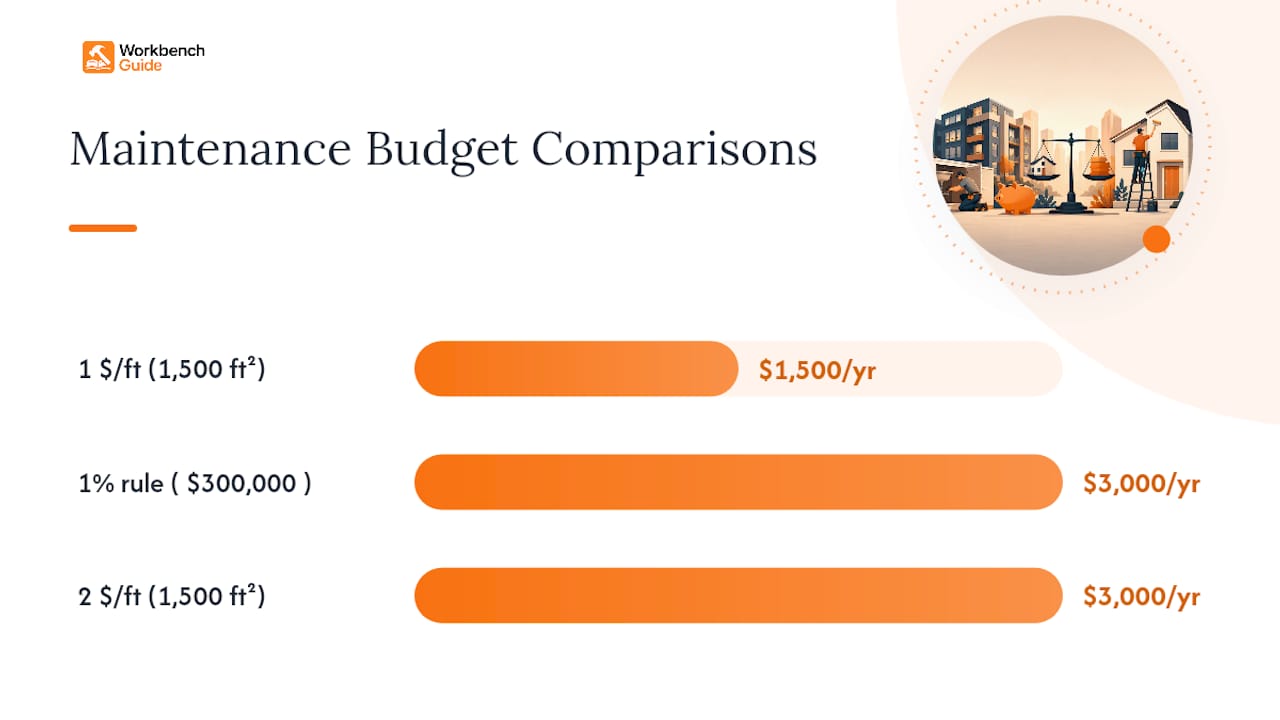
Two rules of thumb get landlords most of the way to a workable number. The 1% rule says to set aside roughly 1% of a property’s market value annually for maintenance and repairs. On a $300,000 rental, that’s $3,000 a year, or $250 a month sitting in reserve. The square-foot rule offers an alternative angle: budget somewhere between $1 and $2 per square foot annually, so a 1,500 square foot rental lands between $1,500 and $3,000, roughly consistent with the 1% figure on a mid-priced home.

Neither rule works in isolation, and both live inside a broader budgeting frame: the 50% rule, which assumes operating expenses (maintenance, taxes, insurance, vacancy, management) will eat close to half of gross rental income over time. If your rent is $2,000 a month, expect something in the neighborhood of $1,000 a month going to expenses across the board, not just repairs, according to common landlord budgeting benchmarks.
Sample reserve math:
- For example, a $250,000 property at 1% budget results in a maintenance reserve of a few thousand dollars annually.
- A $500,000 property requires a proportionately larger reserve.
- Similarly, a 1,200 sq ft unit budgets maintenance costs based on per-square-foot estimates.
Emergency repairs blow past these averages regularly, so treat the reserve as a floor, not a ceiling:
- Plumbing leaks or pipe repairs can range significantly depending on severity and access.
- HVAC repairs vary from minor fixes to full replacements, the latter being a significant expense.
- Water heater replacements also vary based on type and installation complexity.
Older properties, coastal or freeze-prone climates, and anything with deferred maintenance history should push your reserve above these baselines, sometimes by 25% to 50%, because you’re not just maintaining, you’re catching up.
Building a Rental Property Maintenance Schedule
A preventive seasonal rhythm beats reactive maintenance on cost every time, because catching a failing part in March is cheaper than replacing a burst pipe in July. The structure below works for most single-family and small multifamily rentals; adjust frequency for climate and building age as noted.
- Quarterly light checks (every three months): swap or inspect HVAC filters, test smoke and carbon monoxide detectors, and walk the exterior for obvious damage, loose gutters, or pest entry points.
- Spring heavy round: service the air conditioning system before cooling season, clean gutters and downspouts, inspect the roof and siding for winter damage, and check exterior faucets and hose bibs.
- Fall heavy round: service the heating system before it’s needed, weatherproof windows and doors, shut off and drain exterior faucets in freeze-prone regions, and inspect weatherstripping.
- Annual tasks: flush the water heater, clean the dryer vent thoroughly, and run a full safety audit covering detectors, GFCI outlets, and fire extinguishers.
Log every visit with the date, what was done, and any follow-up needed, whether you’re using a notebook, a spreadsheet, or dedicated maintenance calendar templates built for this exact purpose.
Pro Tip: Coastal and high-humidity markets should double the frequency of exterior inspections and add a mid-summer gutter check. Salt air and moisture accelerate corrosion and wood rot far faster than a standard four-season calendar accounts for.
Older buildings, especially anything pre-1990, benefit from an added mid-year electrical and plumbing spot check since original systems tend to show wear that newer construction simply doesn’t.
Common Rental Repairs and What They Typically Cost
Some repairs show up on almost every rental property’s history sooner or later, and knowing the price range in advance keeps you from getting surprised by a vendor quote.
- Smoke and CO detectors: replacement units run $15 to $60 each; NFPA recommends one on every level and outside each sleeping area, tested monthly.
- Water leaks and pipe repairs: $150 to $1,000 depending on whether it’s a fixture leak or a wall-access repair.
- Water heaters: $1,000 to $2,500 to replace; expect 8 to 12 years of service life before failure risk climbs.
- HVAC systems: $150 to $600 for common repairs, $5,000 to $10,000 for full replacement; systems typically last 15 to 20 years with regular servicing.
- Electrical issues: $100 to $500 for outlet or panel repairs; electrical failures rank among the leading causes of home fires, which makes periodic inspection worth the cost.
- Dryer vent cleaning: $75 to $150 annually, cheap insurance against a lint-fed fire.
- Pest control: $100 to $300 per treatment, more for termite or rodent infestations.
- Drywall repair: $75 to $250 per patch depending on size and paint matching.
Red flags that mean replace, not repair: rust stains around a water heater’s base, an HVAC system needing repairs more than once a season, or breakers that trip repeatedly despite fixing the immediate cause.
Operational Systems Every Landlord Should Run
Documentation is the single habit that separates landlords who sail through insurance claims and habitability disputes from those who get burned by them. The standard worth adopting: date, task performed, before and after photos, the vendor invoice, and one line describing the outcome. That level of detail is often decisive when a tenant disputes what work was done or an insurer questions whether damage stemmed from neglect.
Vendor management deserves the same rigor. Build a pre-vetted contact list of a plumber, electrician, HVAC tech, and general handyman before you need one at 11 p.m. on a Saturday, and get written estimates on anything beyond a minor fix so nothing shows up as a surprise line item later. A property manager’s daily coordination routine offers a useful model even for self-managing landlords running just one or two units.
Pro Tip: Put your maintenance request process in writing inside the lease or a tenant handbook: how to report an issue, expected response windows (same day for emergencies, 48 to 72 hours for routine requests), and who to contact after hours. Ambiguity here is what turns a minor delay into a habitability complaint.
Insurance carriers increasingly ask for maintenance records when processing claims, and a documented history of preventive care is often what stands between a paid-out claim and a denial for deferred maintenance.
How Workbench Guide Helps Landlords Run This System
Running a season-by-season calendar across multiple properties by memory or spreadsheet is where most landlords lose the thread. Workbench Guide was built around that exact gap.
- Maintenance calendars that schedule your quarterly checks and spring/fall heavy rounds automatically.
- Multi-property tracking, so a four-unit portfolio doesn’t mean four separate systems.
- Photo and invoice logging attached directly to each task, matching the documentation standard habitability disputes and insurance claims actually require.
- Contractor Q&A access for landlords who want a second opinion before approving a repair quote.
A typical workflow looks like this: onboard a property into the app, schedule seasonal rounds against your local climate, document each visit with photos and notes as your vendor finishes the work, then close the task out with the invoice attached. Sean, a contributor to Workbench Guide’s landlord content, has focused much of his writing on turning scattered maintenance habits into repeatable systems landlords can actually sustain across a full portfolio.
Where to Verify Landlord Legal and Safety Standards
- Cornell Law School’s overview of the implied warranty of habitability explains the legal baseline every landlord operates under.
- NFPA’s smoke alarm guidance covers placement and testing standards for life-safety devices.
- Workbench Guide’s home maintenance checklist turns the seasonal calendar above into a task-by-task resource.
What Most Landlords Get Backward About Maintenance
Most advice on this topic treats legal compliance and cost control as separate problems, one for a lawyer, one for a spreadsheet. That split is the mistake. Every dollar you save by deferring a repair is a dollar of legal exposure you’re carrying instead, because the habitability standard doesn’t care about your cash flow that month.
The conventional wisdom oversells emergency response and undersells the boring stuff. Landlords fixate on having a plumber’s number ready for a burst pipe at midnight, and that matters, but the water heater flush and the dryer vent cleaning you skip every year are what create most midnight emergencies in the first place. Preventive work is unglamorous and it’s also where the actual leverage sits.
If you take one thing from this and change how you operate, make it recordkeeping. Not because a lawyer told you to, but because the habit itself forces you into a preventive mindset. You can’t log a spring HVAC service you never scheduled. The paperwork is a side effect of doing the work; landlords who chase the paperwork first usually end up doing the work too.
Workbench Guide Turns This Playbook Into a System You Actually Run
Reading a maintenance calendar and running one for two years straight are different things, and that gap is exactly where most landlords fall off. Workbench Guide exists to close it: a home maintenance platform built specifically to turn the schedule and documentation habits covered above into automated reminders, centralized records, and a photo-and-invoice trail you can pull up the moment a tenant or an insurer asks for it.
If you’re managing more than one unit, the multi-property tracking alone replaces the spreadsheet-and-email chaos most self-managing landlords default to. And when a repair question gets complicated, contractor Q&A access means you’re not guessing whether a vendor’s quote is fair.
Start with the home maintenance checklist built to match the seasonal calendar in this guide, and see how quickly it turns into a system you don’t have to think about.
Frequently Asked Questions
What is rental property maintenance, exactly?
It’s the combination of scheduled preventive work (filter changes, HVAC servicing, water heater flushing) and reactive repairs landlords perform to keep a unit safe, legally habitable, and in good working order for tenants.
How often should landlords inspect a rental property?
Most landlords run quarterly light checks along with heavier spring and fall rounds, plus an annual deep review covering water heaters, dryer vents, and full safety systems. Older or coastal properties often need more frequent exterior checks.
Who pays for repairs, the landlord or the tenant?
Landlords cover structural, mechanical, and safety-related repairs under the implied warranty of habitability. Tenants are typically responsible for damage they cause and sometimes for minor upkeep like changing light bulbs or HVAC filters, depending on the lease.
What percentage of rental income should go toward maintenance?
The 1% rule suggests budgeting roughly 1% of property value annually, while the broader 50% rule assumes maintenance plus other operating costs will consume close to half of gross rental income over time.
How do I track rental repairs without losing records?
A dedicated maintenance schedule and documentation system, whether a rental property maintenance software platform or a disciplined manual log, should capture the date, task, photos, and invoice for every job so nothing gets lost between tenants or property managers.
This article is general information, not a substitute for advice from a qualified lawyer. Consult a qualified legal professional about your own circumstances before acting on anything here.
Sources
- Implied warranty of habitability — Cornell Law School
- Smoke alarms — NFPA
- Home electrical fires — ESFI
Leave a Reply