
Your home’s HVAC system quietly does more than just keep you warm in winter and cool in summer. For many homeowners, HVAC energy use represents a surprisingly large slice of the monthly utility bill, and it directly shapes the air your family breathes every single day. Yet most people never think about their HVAC until something breaks. This guide walks you through what these systems actually do, why they matter for your comfort, your health, and your wallet, and what simple steps can help you get far more from the system you already own.
Table of Contents
- What does an HVAC system do in a home?
- HVAC, comfort, and indoor air quality: The hidden link
- Efficiency and energy use: How HVAC impacts your bills
- Why maintenance matters: Common mistakes and easy wins
- Going beyond the basics: How system settings and upgrades shift real-world results
- The surprising truth: Why most homeowners leave HVAC savings on the table
- Take control: Bring comfort and savings to your home
- Frequently asked questions
Key Takeaways
| Point | Details |
|---|---|
| HVAC is central to comfort | Your HVAC system directly determines both temperature balance and air quality inside your home. |
| Energy impact is big | Heating and cooling systems can drive up to 39% of household energy use, making their efficiency crucial. |
| Maintenance saves money | Neglecting filter and airflow upkeep cuts efficiency and increases utility costs, even with modern units. |
| Upgrades need smart setup | New HVAC units only deliver savings if tuned and maintained, since real-world efficiency can vary widely. |
| Proper care boosts health | Ventilation and filtration support clean, healthy indoor air, reducing exposure to pollutants and allergens. |
What does an HVAC system do in a home?
Now that we’ve seen the big-picture impact HVAC systems have, let’s get specific about their core functions.
HVAC stands for heating, ventilation, and air conditioning. Each of those three words represents a distinct function, yet they are deeply connected in practice. Together, they work as one system to maintain a livable, healthy indoor environment all year long.
HVAC systems provide heating, cooling, and ventilation to maintain thermal comfort and manage indoor air quality in homes. That three-part responsibility is bigger than most homeowners realize. When any one part lags, all three suffer.
Here is a quick breakdown of what each component actually handles:
| Component | Primary job | Affects |
|---|---|---|
| Heating | Warms air during cold months | Temperature, humidity |
| Ventilation | Moves air in, out, and around | Air freshness, moisture, pollutants |
| Air conditioning | Cools and dehumidifies air | Temperature, comfort, mold risk |
The ventilation piece is often the most overlooked. Fresh air has to get in, stale air has to get out, and the exchange rate matters. A home that is sealed too tight traps pollutants. A home that leaks too much wastes energy. Balanced airflow sits in the middle.
Key roles your HVAC system plays every day:
- Temperature regulation: Keeps indoor temps within a comfortable range regardless of outdoor weather
- Humidity control: Prevents both dry air in winter and sticky humidity in summer
- Air circulation: Moves conditioned air evenly so rooms feel consistent
- Filtration: Captures dust, pollen, pet dander, and other particles on every pass
To stay on top of all these functions, a solid HVAC maintenance guide makes it easy to track what needs attention and when. Scheduling annual HVAC service keeps every component working in sync so the whole system performs as designed.
“An HVAC system is not just a comfort tool. It is a building health system. When it works well, you barely notice it. When it doesn’t, you feel it in every room.”
HVAC, comfort, and indoor air quality: The hidden link
With these roles in mind, it’s crucial to understand how HVAC doesn’t just heat or cool. It is central to both how your home feels and the quality of the air you breathe in it.
Ventilation and filtration strategies can meaningfully improve indoor air quality. Your HVAC supports this through increased airflow and higher-efficiency filtration. The EPA identifies three pillars of good indoor air quality: source control, ventilation, and air cleaners. Your HVAC system touches all three.
Most homeowners set a thermostat and forget it. That approach handles temperature, but it does almost nothing for air quality. Pollutant sources inside a typical home include cooking fumes, cleaning products, off-gassing from furniture, pet allergens, and mold spores. Without active ventilation and proper filtration, those particles cycle through your air again and again.
Here is how different HVAC setups compare for indoor air quality outcomes:
| Setup | Ventilation quality | Filtration level | IAQ result |
|---|---|---|---|
| Basic thermostat, stock filter | Low | Minimal (MERV 4) | Poor to fair |
| Programmable thermostat, upgraded filter | Moderate | Better (MERV 8-11) | Good |
| Smart thermostat, ERV/HRV system | High | Excellent (MERV 13+) | Very good |
| Smart system plus air purifier | Very high | Premium | Excellent |
A few things that make a real difference for air quality:
- Filter ratings matter: MERV ratings (Minimum Efficiency Reporting Value) tell you how well a filter captures small particles. Higher is generally better, but check your system’s specs before going too high since very dense filters can restrict airflow.
- Run times affect quality: Longer fan run cycles move more air through the filter, which means cleaner results even without a fancy system.
- Humidity is non-negotiable: Indoor humidity between 30% and 50% discourages mold growth and makes dust mites less active. Your AC already dehumidifies in summer. In winter, a whole-home humidifier can help.
- Fresh air intake matters: Many homes rely on natural infiltration for fresh air, but adding a controlled fresh air intake gives you predictable ventilation without random drafts.
Pro Tip: If you notice more dust on surfaces right after changing air handler settings, your filter may be the wrong MERV rating for your system. A local HVAC tech can confirm the right match in about five minutes.
Efficiency and energy use: How HVAC impacts your bills
A system that manages both comfort and air quality also quietly shapes your utility costs, and the difference between a well-run and a neglected system can be dramatic.
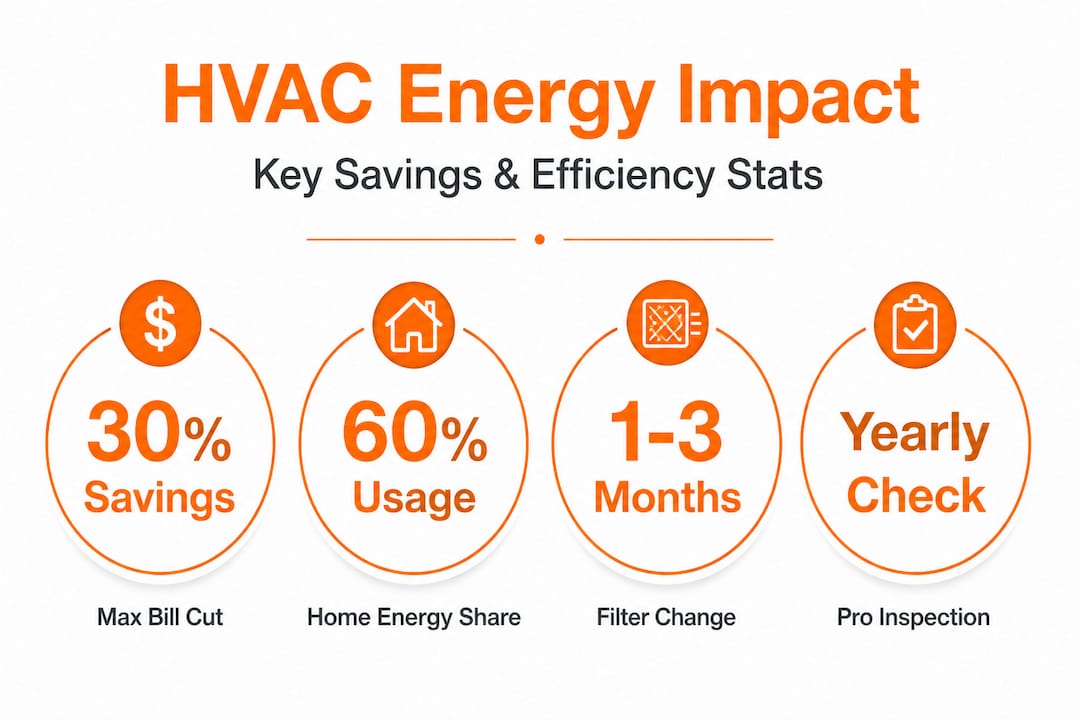
HVAC systems can represent a large energy share in buildings, and smart improvements yield substantial energy and cost savings when they match actual building needs and controls. For most American homes, heating and cooling account for roughly 39% of total energy consumption. That is more than any other household system.
| HVAC condition | Estimated energy efficiency | Monthly bill impact |
|---|---|---|
| Neglected system, dirty filter | 60-70% of rated capacity | 20-30% higher bills |
| Average maintained system | 85-90% of rated capacity | Near-baseline costs |
| Well-tuned, upgraded system | 95-100%+ (heat pumps) | Up to 30% savings |
Steps that move you from average to well-tuned:
- Replace filters on schedule: A clogged filter forces the blower to work harder, consuming more electricity for the same airflow.
- Seal ducts: Leaky ductwork can waste 20 to 30% of conditioned air before it ever reaches the room.
- Program setbacks: Setting temps back 7 to 10 degrees during sleep hours can trim heating costs by roughly 10% annually.
- Check refrigerant levels: Low refrigerant in your AC reduces cooling output and forces the compressor to run longer, burning more electricity.
- Size matters on upgrades: An oversized unit short-cycles (turns on and off too fast), which wastes energy and wears out parts faster.
Stat callout: Smart improvements to HVAC systems can cut energy costs by up to 30%, with an economic payback period typically landing between three and five years depending on your system and climate.
Prioritizing preventative maintenance tips is one of the easiest ways to keep that efficiency edge. It’s also worth understanding appliance maintenance benefits more broadly, since an efficient home usually has several well-maintained systems working together.
Pro Tip: Before investing in a brand-new system, ask an HVAC technician to perform a full load calculation (called a Manual J calculation). It confirms what size equipment your home actually needs. Many homeowners discover their existing system was never sized correctly in the first place.
Why maintenance matters: Common mistakes and easy wins
To truly benefit from your HVAC investment, you need more than a “set and forget” mindset. Maintenance habits are the hidden driver of system success.
HVAC energy efficiency depends strongly on cleanliness and airflow. Neglecting routine maintenance measurably increases energy use and reduces performance, even in high-efficiency, brand-new units. That is not a warning to ignore.
The most common maintenance mistakes homeowners make:
- Skipping filter changes: Filters clog faster than most people expect. In homes with pets or dusty conditions, monthly replacement is often needed.
- Ignoring the outdoor unit: The condenser coil on your outdoor AC unit gets coated with dirt, cottonwood, and debris. A dirty coil can’t reject heat effectively, so the system runs longer.
- Blocking vents: Furniture pushed against supply or return vents disrupts airflow and forces the system to compensate by running more cycles.
- Neglecting the drain line: A clogged condensate drain causes water backup, which can damage your system and encourage mold growth in the air handler.
- Skipping annual inspections: A technician can spot refrigerant leaks, failing capacitors, or worn belts before they become emergency breakdowns.
What you can realistically do yourself:
- Replace air filters every one to three months (check monthly and change when visibly dirty)
- Clear at least two feet of space around the outdoor condenser unit
- Gently rinse the outdoor coil fins with a garden hose each spring
- Check that all vents in the home are open and unobstructed
- Pour a cup of diluted bleach down the condensate drain line twice a year to prevent clogs
Using a solid home maintenance checklist turns these tasks from forgotten afterthoughts into scheduled habits. Small steps done consistently have a bigger payoff than big repairs done reactively.
Going beyond the basics: How system settings and upgrades shift real-world results
Once the maintenance basics are covered, you can maximize comfort and savings by fine-tuning your system and, when the time is right, upgrading with real-world evidence in mind.
One of the most important insights coming from recent research is this: a better label does not automatically mean better results. Heat pump performance in real-world operation can deviate significantly from label expectations. Occupant behavior and system settings both affect measured energy efficiency in the field. That means the homework you do after installation matters just as much as what you buy.
| Upgrade or setting change | Realistic efficiency gain | Cost impact |
|---|---|---|
| Smart/programmable thermostat | 10-15% reduction in heating/cooling use | Low cost, fast payback |
| Air sealing and insulation | Up to 20% total energy reduction | Moderate cost |
| Variable-speed air handler | 10-20% electricity savings vs. single speed | Higher cost, long payback |
| Heat pump (replacing gas furnace) | 30-50% less energy for heating | High cost, significant savings |
| Zoning system | 15-25% reduction with multiple zones | Moderate to high cost |
Stat callout: Optimizing controls and usage patterns can deliver 15% or more in efficiency gains without replacing any hardware at all.
Practical ways to fine-tune your current system:
- Adjust fan mode: Setting the fan to “on” (continuous) rather than “auto” improves air circulation and filtration but uses more electricity. For most homes, “auto” is more efficient unless you have air quality concerns.
- Use setback schedules: Smart thermostats learn your patterns. Even a basic programmable model with a simple weekday/weekend schedule beats a manual thermostat.
- Check refrigerant charge: A system that is even slightly low on refrigerant loses efficiency fast. This is a pro-only check, but it’s worth including in your annual service call.
- Consider zoning: If certain rooms are always too hot or too cold, a zoning system lets you direct conditioned air where it’s actually needed rather than trying to average out the whole house.
Preparing your system for seasonal shifts is also key. A solid winter HVAC prep routine before temperatures drop can prevent mid-winter breakdowns and keep your heating costs in check from day one of the cold season.
The surprising truth: Why most homeowners leave HVAC savings on the table
All the evidence points to one common mistake. Let’s dig into why so many homeowners miss the biggest returns from their HVAC system.
Here’s the reality: the biggest source of wasted HVAC money is not bad technology. It is simple, preventable neglect. Most homeowners treat their HVAC like background plumbing. It runs, it does something, and they ignore it until it stops. That mindset costs real money every single month.
A few myths drive this pattern. The first is “newer is always better.” A brand-new high-efficiency unit run on a clogged filter with leaky ducts and no schedule programming will underperform a well-maintained older unit every single time. Efficiency drops even in high-efficiency units when airflow-restricting components like clogged filters and dirty coils are left unmaintained, because comfort and efficiency are both tied to basic upkeep, not just equipment ratings.
The second myth is “IAQ takes care of itself.” It does not. Ventilation requires intention. Filtration requires regular replacement. Humidity requires monitoring. None of those things happen automatically in a standard home without some level of homeowner engagement.
The third myth is “only pros can help.” Plenty of the highest-impact HVAC actions are DIY-friendly. Changing a filter, clearing debris from the condenser, checking vents, and programming a thermostat require no special tools or training.
What we’ve seen consistently is that homeowners who treat their HVAC as a living system, one that needs seasonal attention and informed settings, spend less on repairs, pay lower utility bills, and live in more comfortable homes. The gap between a passive owner and an engaged one is not expensive equipment. It is habits.
Explore preventing costly home repairs to see how the same principle applies across every major system in your home. Small, consistent checks prevent big, expensive surprises.
Take control: Bring comfort and savings to your home
Ready to shift from passive to proactive? Workbench Guide makes it simple to stay on top of HVAC care without feeling overwhelmed. The preventative maintenance guide walks you through everything from seasonal checkups to filter schedules, with practical steps written for real homeowners rather than technicians. Use the home maintenance checklist to build a full-year plan that keeps your HVAC, along with every other major system, running efficiently. At WorkbenchGuide, you get smart reminders, step-by-step DIY guidance, and contractor recommendations when a job calls for professional hands. Better air, lower bills, and fewer surprises start with knowing what to do and when to do it.
Frequently asked questions
What is the most important function of an HVAC system at home?
An HVAC system maintains home comfort by controlling temperature, ventilation, and indoor air quality, making it one of the most essential systems in any home.
How often should I perform maintenance on my HVAC system?
Replace filters every one to three months, and schedule a professional inspection at least once a year to catch issues before they become costly failures, since routine maintenance directly affects both efficiency and performance.
Can better HVAC maintenance really lower my energy bills?
Yes, proper upkeep combined with smart improvements can cut HVAC energy costs by up to 30%, with savings starting as soon as you address filter changes and basic system care.
Will upgrading to a new HVAC ensure lower bills automatically?
Not necessarily, because real-world heat pump efficiency often deviates from label ratings, and proper setup, maintenance, and usage habits are required to actually reach peak savings.
How does my HVAC system help improve indoor air quality?
Your HVAC improves air quality by cycling stale indoor air out and filtering incoming air through ventilation and filtration strategies that capture pollutants, allergens, and particles on every pass through the system.
Recommended
- How to maintain your HVAC: homeowner guide to boost efficiency
- Why Annual HVAC Service Prevents Repairs and Saves Money
- Winterizing Your Home: Simple Steps to Prevent Costly Repairs
- Preventative maintenance: Save money and protect your home
- How HVAC systems optimize home comfort and energy efficiency – KC Air Control – Heating & Cooling