
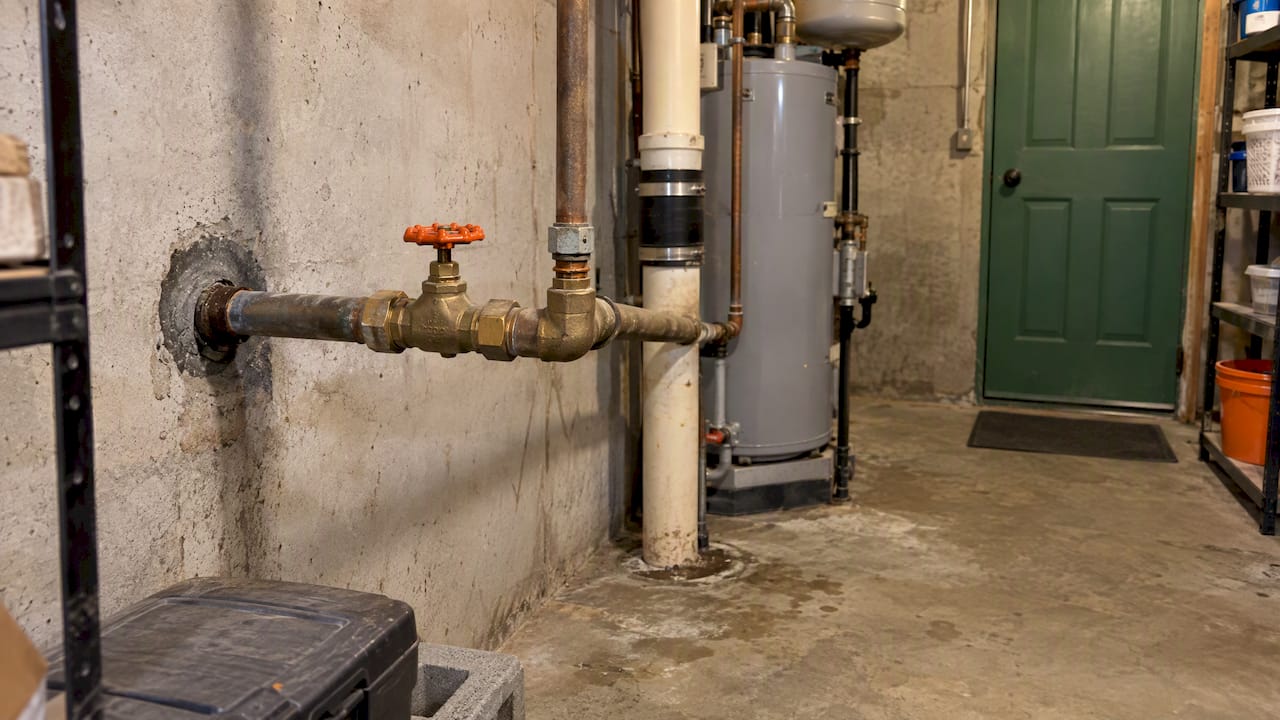
Your main water shut-off valve is usually where the water line enters the house: in a basement, crawl space, garage, utility room or mechanical room, often near the water heater or the water meter. If it is not inside, look outside in the meter box near the street. Find it on a calm day, not while water is pouring through the ceiling.
This guide walks you through where to look in each type of home, how to tell the main valve from the small valves under your sinks, how to test and label it, and what to do if your home has no usable valve at all.
TL;DR
- The main valve is typically where the water pipe enters the house, so start at the front foundation wall, the basement, the crawl space or the garage.
- No valve indoors? Check the meter box near the street. Some homes have only a utility-side shutoff.
- A gate valve has a round wheel that closes clockwise. A ball valve has a lever handle that closes with a quarter turn.
- Test the valve, confirm the water stops at a faucet, and label it with bright tape so everyone in the household can find it.
- If the valve is stuck or missing, do not force it. Call your water provider or a plumber.
Table of Contents
- Where the main shut-off valve usually is inside the house
- If it is not inside, look outside
- Does every house have an indoor shut-off?
- How to recognize the main valve
- A five-step search you can finish in 15 minutes
- Test it and label it
- How to shut off the water in an emergency
- Other shut-offs worth finding while you are at it
- Perspective
- Keep the location where you can find it
- FAQ
- Sources
Where the main shut-off valve usually is inside the house
The main valve controls all the water coming into your home. Utilities describe the location in very similar terms, which makes your search easier: follow the pipe from where it comes in.
WSSC Water says a basement valve is typically within three to five feet of where the main enters, often near the front foundation wall, a mechanical room, the water heater or the furnace. The Western Virginia Water Authority gives the same logic: the master valve is usually where the supply enters the home, such as the basement, a crawl space or the area near the water heater. A Pleasant View Water and Sewer District FAQ adds that it is commonly indoors along the street-facing perimeter of the house.
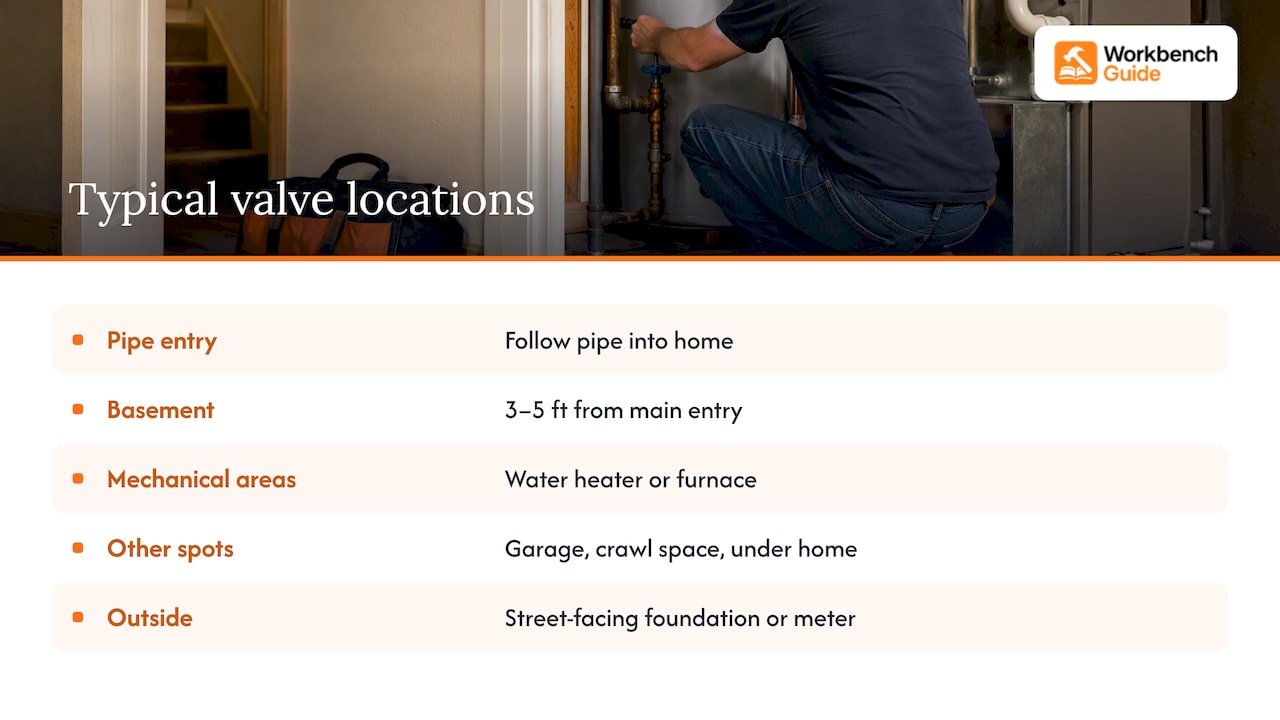
The Regional Water Providers Consortium lists the basement, garage, crawl space, the area under the home and the outside foundation as typical emergency-valve locations. American Water’s homeowner fact sheet says the main shutoff is commonly near the water meter or where the service pipe enters the home.
A quick map by home type
| Home type | Where to look first | Then check |
|---|---|---|
| House with a basement | Front foundation wall, within a few feet of where the pipe enters | Near the water heater or furnace, mechanical room |
| House on a crawl space | Where the pipe comes up through the floor or foundation, often under the house | Access panel, closet or garage |
| Slab-on-grade house | Garage, utility room or storage area | Outside by the foundation, then the meter box |
| Condo or apartment | Inside the unit, under a sink or in a utility closet | Ask the property manager or HOA |
| Manufactured home | Near where the supply line enters under the home | Meter box at the property edge |
The table is a starting point. Plumbing runs differently from house to house, so follow the pipe rather than trusting the layout of the neighbors’ homes.
If it is not inside, look outside
Some valves sit outdoors. The Western Municipal Water District notes the master valve may be in the front, side or backyard, or in a garage, and that the customer shutoff may be inside the meter box near the street.
Here is what to scan for outside:
- Near an outdoor faucet. Follow the pipe back along the wall.
- Beside the foundation on the street-facing side, where the line enters.
- A meter box in the ground. Look for a round or rectangular metal or plastic lid flush with the grass or sidewalk, usually near the street or the property line.
- Near a private well’s pump and pressure tank, if you are not on city water.
Austin Water says the property owner’s shutoff is typically on the owner’s side of the meter in the meter box. It also says renters should check with the property manager, and that a city shutoff may be used if the owner’s valve is missing or damaged.
Leave the utility’s equipment alone
The San Francisco Public Utilities Commission says the valve may be on the exterior or just inside the property, in line with the sidewalk water meter, and may sit high up or far below the water main. It also says meters should be accessed only by field staff, and asks customers to request a site visit. The meter and the valve on the utility’s side belong to the utility. Your valve is the one on your side of the meter. If you cannot tell which is which, call the utility’s number on your water bill.
Does every house have an indoor shut-off?
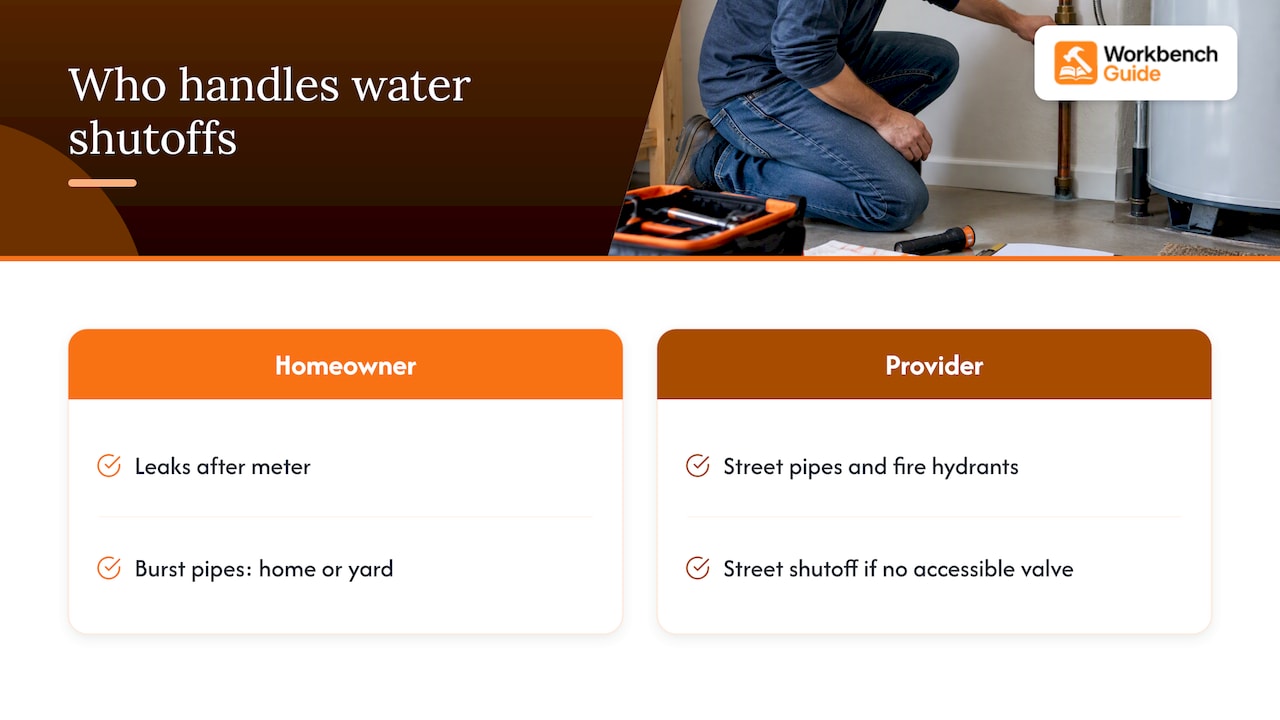
No. The Regional Water Providers Consortium says many apartments, manufactured homes and older homes may lack an accessible shutoff, in which case you call your water provider to turn off the water at the street. It also says owners are responsible for burst pipes inside the home or yard, while providers are responsible for street pipes and fire hydrants.
That split matters. A leak after the meter is yours to stop and fix. WSSC Water says homes it serves were required to have an indoor main shutoff when built under its guidance, but outside underground property-line valves may still require a registered master plumber or the utility itself. Rules vary by utility, so check with yours.
If you rent, the valve is typically the property manager’s responsibility to point out. Ask for its location in writing when you move in.
How to recognize the main valve
Once you are near the entry point, you need to know what you are looking at. The American Water fact sheet describes two common styles:
- Gate valve: a round wheel handle. You turn it clockwise to close it.
- Ball valve: a lever handle. It closes with a quarter turn, and the handle sits perpendicular to the water line when closed.
The SFPUC says an outdoor main valve is typically the largest valve coming out of the wall, and may be a circular gate valve or a ball valve with a blue handle.
Main valve versus fixture valves
The small oval-handled or screw-style valves under sinks and behind toilets are fixture supply valves. Western Municipal Water District separates the master valve, which shuts off the whole house, from supply valves serving individual fixtures or appliances such as sinks, toilets and washing machines. Close a sink valve and only that sink stops. Those are useful for a leaking faucet, but they will not help when a pipe bursts in the wall.
A five-step search you can finish in 15 minutes
- Confirm your water source. City water means a meter and a utility. A private well means a pressure tank and pump, and your shutoff is near them.
- Walk the street-facing wall inside. Check the basement, garage, utility room and storage areas along that perimeter first, since that is where the line commonly enters.
- Check the water heater area. Many valves sit within a few feet of the heater or furnace. Our water heater maintenance guide covers the heater’s own shutoff, which is a separate valve on its cold-water inlet.
- Go outside. Look by the foundation, near hose bibs, and for a meter box lid near the curb.
- Check paperwork. The Pleasant View district notes that a property inspection report may identify the valve. Closing documents or old plumbing permits may also help.
Still nothing? The Regional Water Providers Consortium advises contacting a plumber if the valve cannot be found. Many utilities will also tell you where the meter and shutoff are if you call.
Test it and label it
Finding the valve is only half the job. The Western Virginia Water Authority recommends testing the suspected master valve, confirming that water stops at fixtures, and labeling the valve with bright tape or a sign. It also stresses making sure everyone in the household knows where it is.
A simple test:
- Open a faucet at the lowest or farthest point, such as a basement sink or outdoor spigot.
- Close the suspected valve slowly. A gate valve turns clockwise. A ball valve turns a quarter turn.
- Check that the flow at the faucet slows and stops. American Water says to check sinks and other fixtures after closing to verify you have the right valve.
- Reopen it slowly. Opening it fast can send a surge through the pipes.
- Tag it and take a photo for your records.
Do this once a year. Valves that sit untouched can seize. If one will not turn easily, American Water advises against forcing it because it may break. A stuck valve is a job for a plumber, not a bigger wrench.
How to shut off the water in an emergency
When a pipe bursts, speed matters, but so does doing it right. The Regional Water Providers Consortium says to turn the handle to the right until snug, then open faucets and flush toilets to drain water and reduce pressure. If there is no shutoff valve, call your water provider. If the valve appears stuck, check with a plumber.
After the water is off:
- Turn off the water heater’s power or gas if the leak is near it, so the tank does not heat while empty or damaged.
- Stay away from outlets and electrical panels if water is near them. If you need to find the right breaker, see our guide to labeling your electrical panel.
- Photograph the damage before you clean up, for insurance.
- Call a plumber for the repair.
If you expect to be stuck without a working valve, line up a local plumber’s number in advance. For a Canadian-market example of the kind of leak-repair service homeowners compare, there is a leak repair service in Saint-Bruno-de-Montarville, though your best option is a licensed local plumber in your own area.
Should you leave faucets open afterward?
In a burst-pipe emergency, yes: opening faucets and flushing toilets drains the pipes and reduces pressure, as the Consortium advises above. In cold climates, American Water says outdoor-faucet isolation valves are usually in the basement, one valve may control all outdoor faucets, and closing the inside valve while opening the outside faucet drains remaining water. Our plumbing winterizing checklist walks through that seasonal routine.
Other shut-offs worth finding while you are at it
The main valve is the big one, but a home has a handful more you will want mapped:
- Water heater cold-inlet valve. Lets you isolate the tank for maintenance or a leak. See our guide on why you should service your water heater regularly.
- Toilet supply valves. Handy for a running or leaking toilet. Our walkthrough to fix a running toilet starts here.
- Sink and dishwasher valves. Under the cabinet.
- Washing machine valves. Behind the machine, usually two for hot and cold.
- Outdoor faucet isolation valve. Usually in the basement, per American Water.
- Spa or hot tub valves. A hot tub has its own plumbing. If you own one, it helps to know when spa check valve replacement stops being a DIY job.
Walk through once, tag each valve, and write down what it controls. Ten minutes now saves you guessing later. If you want to go further into repairs, our step-by-step plumbing repair guide picks up from here, and why you should check plumbing yearly explains the routine.
Perspective
Most homeowners we hear from learn where the main valve is the hard way: standing in an inch of water, flashlight in hand, guessing. The valve is rarely hidden. It is just never written down.
Our view is that a shut-off valve is a record-keeping problem as much as a plumbing one. You find it once, test it, tag it, photograph it, and then the knowledge has to live somewhere other than your head. Spouses, kids, house sitters and the next owner should be able to find it in thirty seconds.
That is why we built Workbench Guide around reminders, checklists and records. A yearly reminder to exercise the valve, a photo with a note on its location, and a checklist for what to do next turn a stressful moment into a routine one. We designed our step-by-step guides to carry professional contractor knowledge to people who are not contractors, so you can act with confidence and know when to call someone.
Sean
Keep the location where you can find it
A valve you located two years ago is a valve you may have forgotten. Workbench Guide lets you store photos and notes about your home systems, set a recurring reminder to test your valve, and follow checklists such as our home maintenance checklist. The Homeowner plan is $7 per month or $70 per year, and Owner Plus is $12 per month or $120 per year. See the pricing page for what each plan includes, or start from the Workbench Guide home page.
If you manage rentals, the same approach works for every property. Record each valve’s location once, and the next tenant turnover or emergency call goes faster.
FAQ
Do you leave faucets open after shutting off the water?
For a burst pipe, yes. The Regional Water Providers Consortium says to open faucets and flush toilets to drain water and reduce pressure. Once the repair is finished, close the faucets and reopen the main valve slowly, then check fixtures and joints for leaks.
Who is responsible for the main water shut-off valve?
Generally, you are responsible for plumbing inside your home or yard, and the water provider is responsible for street pipes and hydrants. The valve inside your house is typically yours to maintain. Utility-owned meters and street-side valves are the utility’s, so call them rather than operating that equipment yourself. Renters should ask the property manager.
Does every house have a water shut-off valve inside?
No. Many apartments, manufactured homes and older homes may lack an accessible shutoff. In that case, call your water provider to shut the water off at the street, and consider asking a plumber about adding an accessible valve.
What if the main valve is stuck or will not turn?
Do not force it. American Water warns that a valve that does not turn easily may break. Call a plumber, and if water is actively flooding the house, call your water provider to shut it off at the street.
How do I tell the main valve from a regular shut-off valve?
The main valve sits where the water line enters the house or near the meter, and closing it stops water at every fixture. Fixture valves sit under sinks or behind toilets and affect only one fixture. Test by closing the valve slowly and checking a faucet.
Sources
- Find and Operate Your Main Water Valve, WSSC Water
- Locate Your Main Water Valve, Western Virginia Water Authority
- Frequently Asked Questions, Pleasant View Water and Sewer District
- Emergency Water Shut-Off, Regional Water Providers Consortium
- Know How to Shut Off Your Water, American Water
- Home Water Shutoff Valve, SFPUC
- How to Turn Off Your Water, Western Municipal Water District
- Austin Water Cold Weather Tips, Austin Water
Leave a Reply