
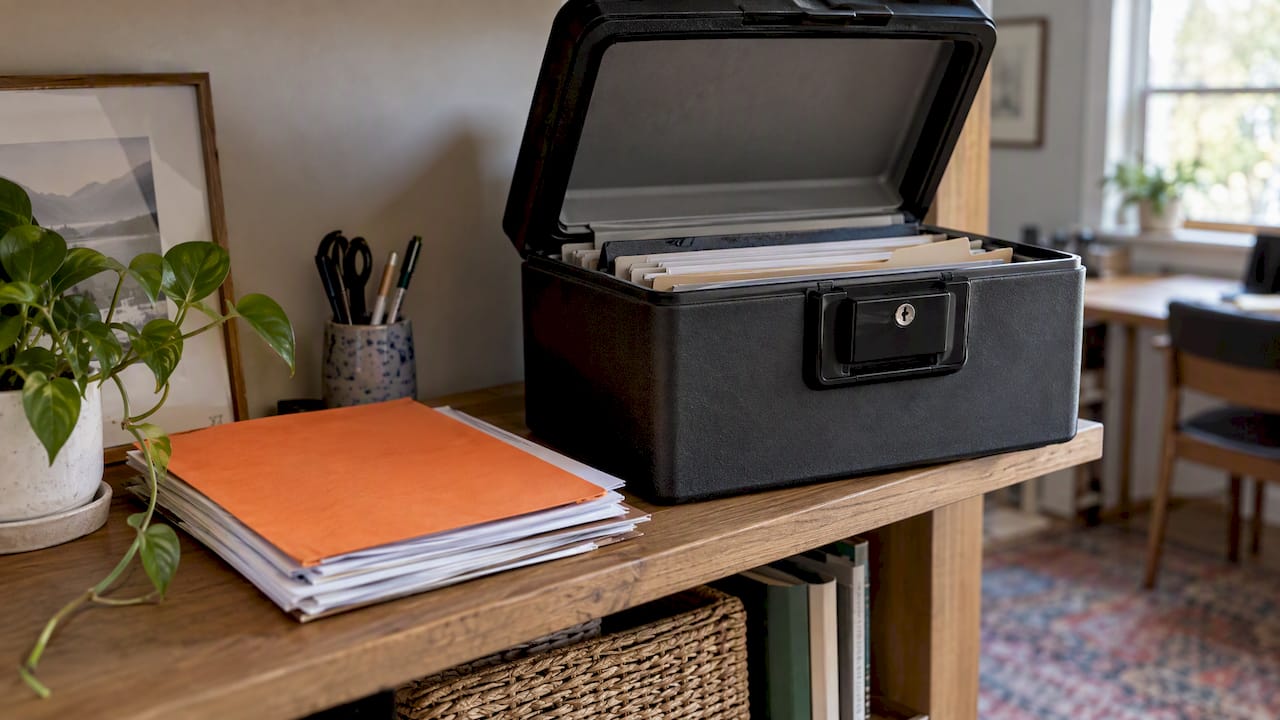
Good homeowner record keeping comes down to four piles: the papers that prove you own the home, the receipts that prove what you spent on it, the logs that show how you maintained it, and the policies that protect it. Keep the first group for as long as you own the house. Keep the tax-related ones until the IRS window closes after you sell. Keep the rest in one place where you can find them in two minutes, not two hours.
This guide walks through each pile, what to write down, how long to hold it, and how to store it safely.
TL;DR
- Save your whole closing packet, including the Closing Disclosure, promissory note, mortgage or deed of trust, and the deed. Keep it for as long as you own the home.
- Keep receipts for capital improvements (roof, addition, kitchen remodel). They raise your home’s tax basis. Ordinary repairs and painting generally do not.
- For tax purposes, the IRS generally says to keep home records until three years after the due date of the return for the year you sell.
- Log maintenance as it happens: date, what was done, who did it, cost, and the model and serial number of anything installed.
- Store paper in a fireproof, waterproof box and keep digital copies backed up in a second location.
Table of Contents
- Why homeowner records matter more than most people expect
- Start with your closing packet
- Keep proof that you own and live in the house
- Improvements versus repairs: the distinction that affects your taxes
- What to log for maintenance, contractors, appliances and warranties
- How long to keep each type of record
- Where to store records so you can find them
- Our perspective: records fail when they depend on memory
- Build your system in four steps
- Keeping it all in one place with Workbench Guide
- Frequently asked questions
- Sources
Why homeowner records matter more than most people expect
Most people think of records as a tax chore. In practice they do four jobs.
They lower your tax bill when you sell. Your gain on a sale is based on your adjusted basis, which starts with the purchase price and grows with qualifying improvements. Without receipts, you cannot prove the higher number.
They prove ownership and occupancy. After a fire, flood or storm, you may need to show you own and live in the home. That is much easier when the papers are in one folder.
They support insurance claims. A dated list of what you own and photos of what the house looked like before damage make a claim faster to document.
They protect resale value. A buyer who sees a roof invoice, a furnace service history and a list of permitted work has fewer reasons to haggle.
If you want the maintenance side of this handled on a schedule, our guide to organizing home maintenance with a two-minute monthly habit shows how to keep the log current without a big weekend project.
Start with your closing packet
The Consumer Financial Protection Bureau advises homeowners to save their entire closing packet, specifically the Closing Disclosure, the promissory note, the mortgage (security instrument or deed of trust) and the deed. These are the foundation of every other record you will keep.
What each one does for you:
- Closing Disclosure: the final itemized costs of the purchase. It helps establish your starting cost basis.
- Promissory note: your promise to repay the loan, with its terms.
- Mortgage or deed of trust: the document that secures the loan against the property.
- Deed: the document that transfers title to you.
Also keep the inspection report, the survey if you received one, the title insurance policy, and any seller disclosures. These are not on the CFPB’s list, but they answer questions years later, such as where the property line runs or what the seller said about past water problems.
One more point from the same CFPB page: after closing, your information becomes a matter of public record, which can lead to junk mail or potential scams. Treat unexpected letters about your deed or mortgage with suspicion, and do not pay a company that offers to “copy” a record you can request yourself from the county.
Keep proof that you own and live in the house
Proof of ownership sounds like something you will never need until you do. FEMA lists what it accepts when verifying a disaster-assistance applicant: according to its fact sheet on verifying home ownership or occupancy, an original deed, a mortgage statement, a property tax receipt or property insurance documentation can show ownership. Utility bills can verify that you live there.
The same page notes that most documents may be dated within one year before the disaster and/or the 18-month assistance period. That makes a practical case for keeping the current year’s mortgage statement, property tax bill, insurance declarations page and a recent utility bill together in one folder, replaced each year.
If you ever need to prove you are the owner for a bank, a contractor or a permit office, the same set of papers usually does the job.
Improvements versus repairs: the distinction that affects your taxes
This is the line that trips up most homeowners. According to IRS Publication 523, improvements such as a new roof, an addition or a kitchen modernization add to your home’s basis. Repairs and maintenance, such as painting or fixing leaks, do not.
The IRS requires you to document the property’s adjusted basis, which includes the original purchase price and the cost of capital improvements. Many sellers owe nothing on their gain because of the home sale exclusion, but values rise, and a home owned for twenty years can have a large gain. Proving a $30,000 kitchen remodel from 2012 is far easier if you saved the contract and the payment records.
What to save for each improvement
- The signed contract or estimate and the final invoice
- Proof of payment: a cancelled check, card statement or bank transfer record
- Permits and final inspection sign-offs, where required
- Before, during and after photos (see our guide to photographing home projects so they are resale ready)
- Warranty documents for the work and the materials
What to save for repairs
Repairs do not raise your basis, but keep the records anyway. They show the house was cared for, they establish when something last failed, and they matter if you ever rent part of the property or claim a home office, where different tax rules apply. A tax professional can tell you how those rules apply to your situation.
For a full system for the paper and digital receipts themselves, read how to organize home receipts so you keep them up.
What to log for maintenance, contractors, appliances and warranties
No agency publishes a required format for a home maintenance log, so this part is practical judgment. The goal is that someone who has never seen your house, a new owner, an insurer or a contractor, could read the record and know what was done and when.
For every maintenance or repair event, write down:
- Date. The day the work was done, not the day you paid.
- What was done. “Replaced water heater anode rod” beats “plumbing.”
- Who did it. Company name, technician, phone number and license number if applicable. If you did it yourself, say so.
- Cost. Parts and labor, with the invoice attached.
- What is next. The date the task is due again, such as a filter swap or annual furnace service.
For every major system and appliance, keep a single reference entry:
- Brand, model number and serial number (photograph the data plate)
- Install date and who installed it
- Warranty length, registration confirmation and the warranty terms
- Manual, saved as a PDF
- Filter sizes, bulb types, or part numbers you reorder
A few extras that pay off: paint colors and brands for each room, flooring and tile product names, the location of the main water shutoff and electrical panel, and a list of contractors you would hire again. When a tile cracks in year six, the leftover-material record saves you a long search.
Mistakes that make logs useless
- Writing only what failed. Routine work is the evidence of care. Record gutter cleaning and filter changes too.
- Keeping the record in someone’s head. If only one spouse knows where the receipts are, the system is one illness away from failing.
- Leaving out the serial number. Warranty claims and recalls depend on it.
- Saving photos without labels. A picture of a pipe means little without a note on the room, date and reason.
How long to keep each type of record
The IRS gives a general rule on its page about how long to keep records: generally keep tax records for three years, with exceptions. For property, keep records until the limitation period expires for the return covering the year you dispose of the property. Publication 523 applies this to home sales: to document your home’s adjusted basis, generally keep records until three years after the due date of the return for the year you sold.
In plain terms, the clock for most home records does not start when you buy or when you spend the money. It starts when you sell. A receipt from your first year of ownership may need to survive twenty years.
University of Wisconsin-Madison Extension takes a cautious approach in its financial records guide: keep mortgage and housing information for as long as you own the property, plus four years for tax purposes. That extra year of margin is easy to adopt.
| Record | Keep for | Why |
|---|---|---|
| Closing packet (Closing Disclosure, note, mortgage, deed) | As long as you own the home, then through the tax window after the sale | Establishes ownership, loan terms and starting basis |
| Capital improvement receipts and contracts | Until the tax limitation period ends for the year you sell | Adds to adjusted basis |
| Repair and routine maintenance records | As long as you own the home | Shows care, supports claims and resale |
| Property tax bills and mortgage statements | Current year in your ownership folder; tax-related copies per IRS guidance | Proof of ownership and deductions |
| Homeowners insurance policy | As long as the policy is in force, plus the claim files for any losses | Coverage terms and claim history |
| Appliance manuals and warranties | Until the warranty ends and you no longer own the item | Warranty claims |
| Sale documents (settlement statement, sale contract) | Until the tax limitation period ends for the year of sale | Calculates your gain |
This table is a general guide. Your state may have its own tax rules, and your situation may call for longer retention. A CPA or enrolled agent can confirm what applies to you, especially if you ever rented the home, ran a business from it or claimed a casualty loss.
What about records after you sell?
A common reader question is what to keep after selling. Keep the closing statement from the sale, the original purchase closing papers, and the improvement receipts that support your basis until the IRS window closes, which is generally three years after the due date of the return for the year of the sale. Many people keep these for longer, and EisnerAmper notes in its real estate record guide that organized records also help you prove that the home was your primary residence when you claim a tax exclusion.
Where to store records so you can find them
The UF/IFAS Extension publication on keeping a household inventory and protecting valuable papers suggests keeping property records, home improvement records and insurance policies in a safe deposit box, and valuable papers in a waterproof, fireproof locked box at home. That is sound advice for originals such as the deed copy you received and the signed note.
For everything else, a hybrid approach works best.
Physical copies
- One fireproof, waterproof box for originals you cannot replace
- One accordion file or binder for the current year: statements, tax bills, active warranties
- Manuals in a single labeled bin instead of scattered drawers
Digital copies
- Scan or photograph every document the day you receive it. A paper pile grows faster than a monthly cleanup session can shrink it.
- Use a consistent file name: year, month, item, vendor. For example, “2026-03-roof-replacement-invoice.pdf.”
- Store the files in two places, such as your computer and a cloud service, so a single failure does not wipe the record.
- Protect the account with a strong, unique password and two-factor authentication. These files contain account numbers and your address.
Plan for the worst day
Before hurricane season or any evacuation, make sure your key papers and photos can travel with you or be reached from a phone. Our 48 and 36 hour hurricane home prep checklist includes the records worth grabbing first.
Our perspective: records fail when they depend on memory
We built Workbench Guide around a simple observation. Homeowners rarely lack the willingness to keep records. They lack a place where the records naturally go. A shoebox, a spreadsheet, a notes app and an email folder each hold part of the story, and nobody can say which has the water heater install date.
The pattern we see is that record keeping works when it is tied to a task. You change the furnace filter, you log it. A contractor finishes a job, you attach the invoice to the item it concerns. When the record is a by-product of the work, it stays current. When it is a separate project, it falls behind by March.
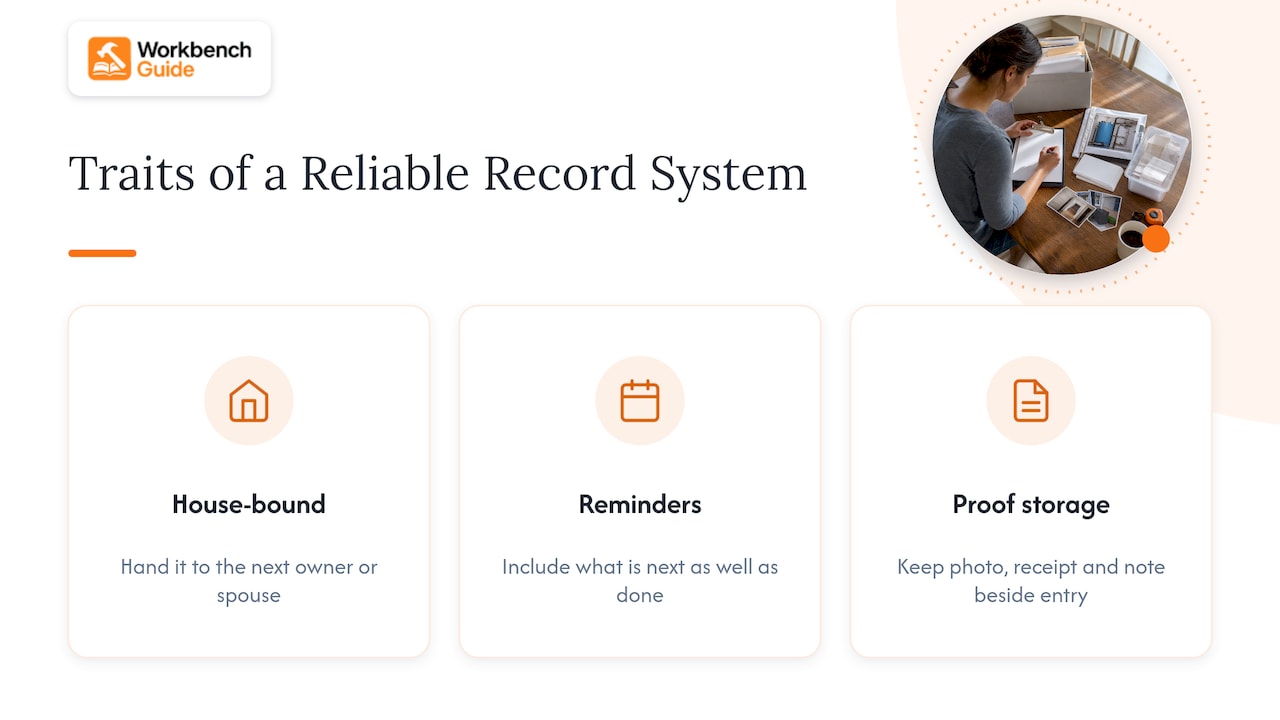
That is why we think a good system has three traits. It is attached to the house, not to a person, so it can be handed to the next owner or a spouse. It reminds you, so that the record includes what is next as well as what is done. And it stores the proof, the photo, the receipt and the note, beside the entry, so you are not hunting for it. If you own more than one property, the same system should separate them cleanly so one rental’s roof invoice never lands in your own house’s folder.
Whatever tool you use, pick the one you will open on a tired Tuesday. A simple record that is updated beats a perfect one that is not.
— Sean
Build your system in four steps
- Gather the foundation. Locate your closing packet, deed, title policy, current insurance declarations page and latest property tax bill. Scan them and put the originals in your fireproof box or safe deposit box.
- Make one entry per major system. Walk the house with your phone. Photograph data plates on the furnace, water heater, air conditioner, appliances and roof documentation. Write the install date if you know it, or mark it unknown.
- Add the improvements. List each project since you bought: what it was, the year, the cost and where the receipt lives. Where you cannot find a receipt, look for a bank or card statement that proves the payment.
- Set the habit. Pick a fixed time each month, ten minutes is enough, to log completed tasks and file new receipts. Our guide to a two-minute monthly maintenance habit describes how to keep the routine light.
If you are starting from nothing, do step one this week and the rest over a month. Partial records are still worth far more than none.
Keeping it all in one place with Workbench Guide
If you would rather not build this from folders and spreadsheets, Workbench Guide keeps your maintenance reminders, repair tracking, photos, notes and home records in one place, with step-by-step DIY guides and contractor Q&A when a task goes beyond your comfort. The Homeowner plan is $7 per month or $70 per year, and Owner Plus is $12 per month or $120 per year. Landlords and property managers can see the multi-property plans too. Compare plans on our pricing page.
Frequently asked questions
What documents should I keep after selling my house?
Keep the settlement statement from the sale, the closing papers from your original purchase, and receipts for capital improvements. The IRS generally says to keep records that document your home’s adjusted basis until three years after the due date of the return for the year of the sale. If your situation is complicated, ask a tax professional before you discard anything.
Do I really need to keep records for seven years?
Seven years is a popular rule of thumb, but the IRS’s general guidance for tax records is three years, with exceptions. For a home, the clock starts when you sell, so home records often must be kept far longer than seven years from when you created them. Keeping them through ownership plus a few years is the safest approach.
How can I show proof of home ownership?
A deed is the primary document. FEMA also accepts a mortgage statement, a property tax receipt or homeowners insurance documentation to verify ownership after a disaster, and utility bills to verify occupancy. Keep recent copies of each together so you can produce them quickly.
Are repairs and improvements recorded the same way?
Keep records of both, but understand they are treated differently for taxes. Per IRS Publication 523, improvements such as a new roof or addition add to your basis, while repairs such as painting or fixing leaks do not. Log them separately so the improvement total is easy to calculate at sale time.
Should records be paper or digital?
Use both. Keep irreplaceable originals in a fireproof, waterproof box or safe deposit box, and keep scanned copies in two digital locations. Name files consistently so you can find them by year and item.
Sources
- After closing, Consumer Financial Protection Bureau
- Verifying Home Ownership or Occupancy Information, FEMA
- Publication 523, Selling Your Home, IRS
- How long should I keep records?, IRS
- Financial Records: What to Keep, University of Wisconsin-Madison Extension
- Real Estate Document Retention, EisnerAmper
- Keeping a Household Inventory and Protecting Valuable Papers, UF/IFAS Extension
Leave a Reply